
Blog
Why Does My Back Hurt After Sleeping? Expert Tips

You wake up in the morning, swing your feet onto the floor, and your back lets you know it's unhappy before the coffee's even brewing. Around Central Maine, that's a familiar complaint. Maybe you spent the day hauling wood, working on your feet, chasing kids, or getting outside while the weather was good. Then you go to bed expecting recovery, and instead you wake up stiff, tight, or sore.
If you've been asking why does my back hurt after sleeping, the answer usually isn't as simple as “I need a new mattress” or “I slept wrong.” Most of the time, it's a mismatched sleep system. Your mattress, pillow, and sleep position all work together, or work against each other. When they're out of sync, your body pays for it by morning.
A lot of folks feel relieved just hearing that, because it means the problem is often practical. It's a puzzle you can work through. And if you've lived in Maine long enough, you know that practical fixes usually beat fancy talk.
Table of Contents
- Waking Up with Back Pain in Central Maine
- Understanding Why Your Back Hurts in the Morning
- How Your Mattress Contributes to Back Pain
- Adjusting Your Sleep Position for Pain Relief
- How to Find the Right Mattress for Your Body and Budget
- Long-Term Prevention and When to See a Doctor
Waking Up with Back Pain in Central Maine
In Augusta, Skowhegan, and all across Central Maine, morning back pain often starts the same way. You slept a full night, but your body feels like it didn't get the message. You stand up slowly. You stretch a little. Maybe you lean on the bathroom counter for a second and wait for things to loosen up.
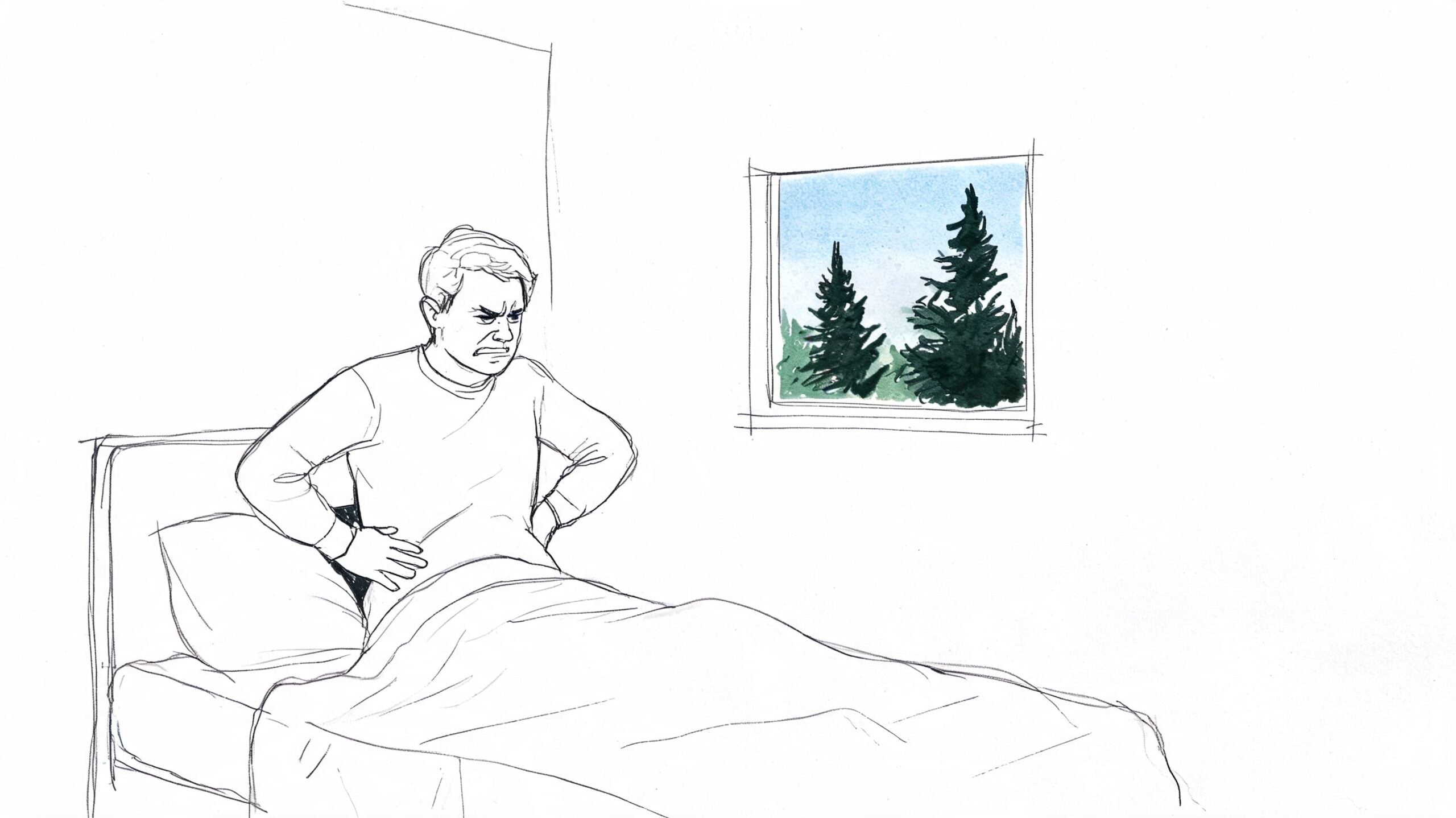
That doesn't always mean something is seriously wrong. It often means your body spent the night in a position that added strain instead of taking it away. A lot of people assume back pain after sleep must come from one dramatic cause, but it's usually the result of several small things stacked together.
A common Maine morning
One person might be sleeping on an older mattress that sags in the middle. Another might have a perfectly decent mattress but a pillow that pushes the neck too high. Someone else might be a lifelong stomach sleeper whose lower back gets pulled into a strained position night after night.
Neighborly truth: Morning pain is frustrating, but it's often easier to improve than people think.
That's why the better question isn't just, “Is my mattress bad?” It's, “Is my whole sleep setup supporting my body the way it should?”
Here's the short version of what usually matters most:
- Your mattress support: It has to hold your body in a more neutral position, not let you sag or perch awkwardly.
- Your sleep posture: Side, back, and stomach sleeping all load the spine differently.
- Your pillow setup: Your head and neck affect the rest of your spinal alignment more than is generally realized.
- Your body's own history: If you already deal with stiffness or a back condition, a poor setup tends to show itself fast in the morning.
Folks who stop by a showroom often think they need one magic answer. Most don't. They need a better match between body, bed, and habits. That's a more useful way to look at it, especially if you want relief that lasts longer than one good night.
Understanding Why Your Back Hurts in the Morning
Back pain after sleep is common partly because back pain in general is so common. The World Health Organization says low back pain affected about 619 million people globally in 2020, and that figure is projected to rise to roughly 843 million by 2050, as noted in Sleep Foundation's review of waking up with lower back pain.
Your spine wants even support
A simple way to think about your spine is to picture a bridge. If the support underneath is even, the structure stays steady. If one section dips or twists, the pressure gets redistributed to places that weren't meant to carry it that way.
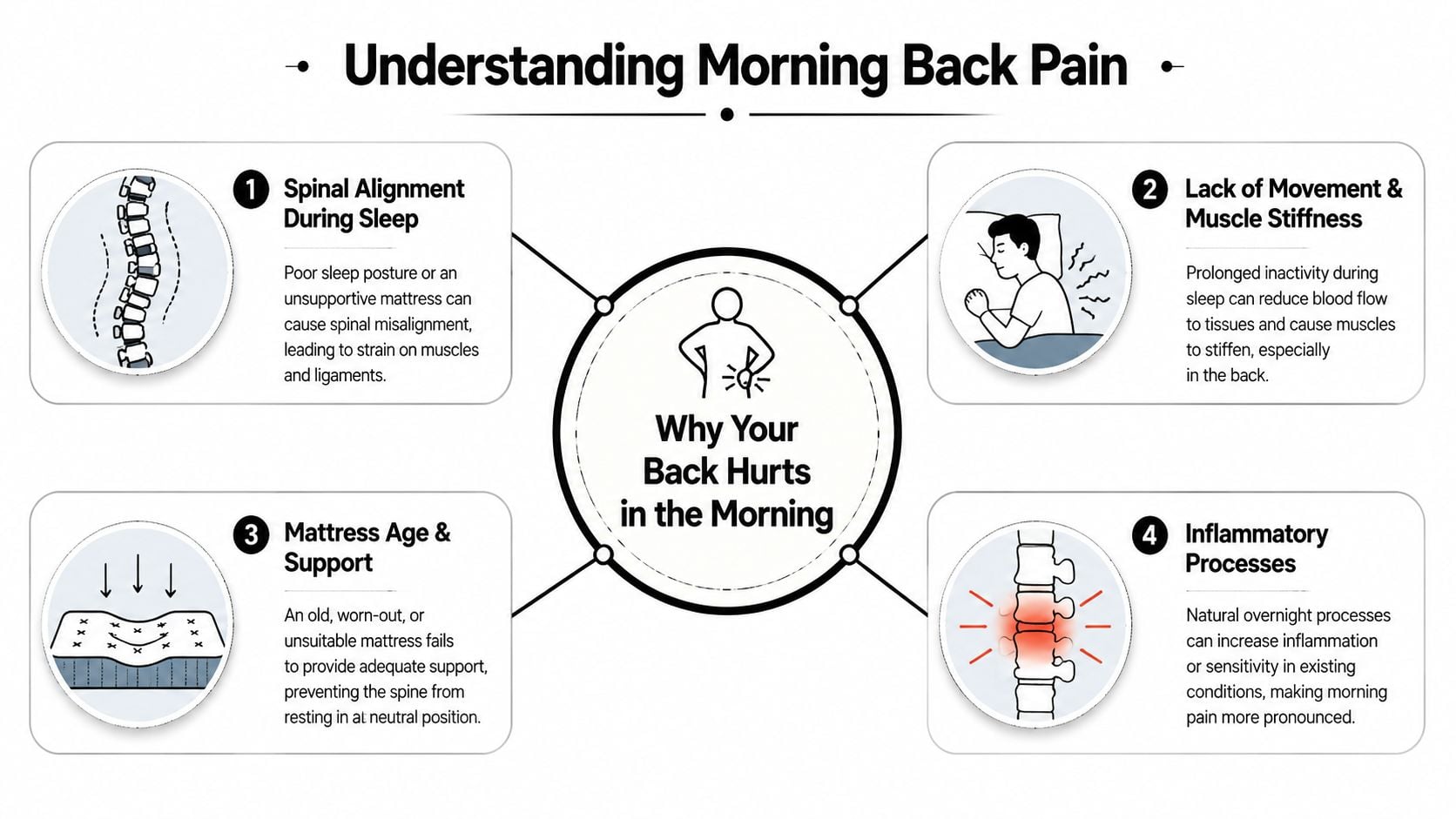
Your body works much the same way during sleep. If your hips sink too far, your shoulders stay too high, or your neck angles off to one side, the muscles and joints around your spine have to absorb that strain for hours. By the time you wake up, those tissues can feel tight and irritated.
This is why neutral spinal alignment matters so much. That phrase sounds technical, but it just means your spine is resting in a more natural position instead of being bent, flattened, or overextended.
Why pain often shows up first thing
One reason people get confused is that the pain can ease up once they start moving. That doesn't mean the bed wasn't involved. It often points right back to the bed.
Sleep Foundation notes that the Cleveland Clinic explains how lying still for seven to eight hours can allow stiffness and inflammation to build up, which is why pain may be most noticeable when you first get moving in the morning. In plain English, you were in one position long enough for your body to get cranky.
A few patterns tend to show up again and again:
| Sleep issue | What happens overnight | What you may feel in the morning |
|---|---|---|
| Poor alignment | Muscles and joints hold strain | Tightness or a dull ache |
| Long periods without movement | Stiffness builds | Slow, stiff first steps |
| Pressure in the wrong spots | Sensitive areas get overloaded | Soreness in low back, hips, or shoulders |
Your back may hurt after sleeping not because sleep is harmful, but because your body didn't get the support it needed while you were still.
If you're dealing with ongoing discomfort, it can help to compare your setup with guidance on mattresses for chronic back pain. The key idea is the same. Sleep should let your spine rest, not fight to stay comfortable.
How Your Mattress Contributes to Back Pain
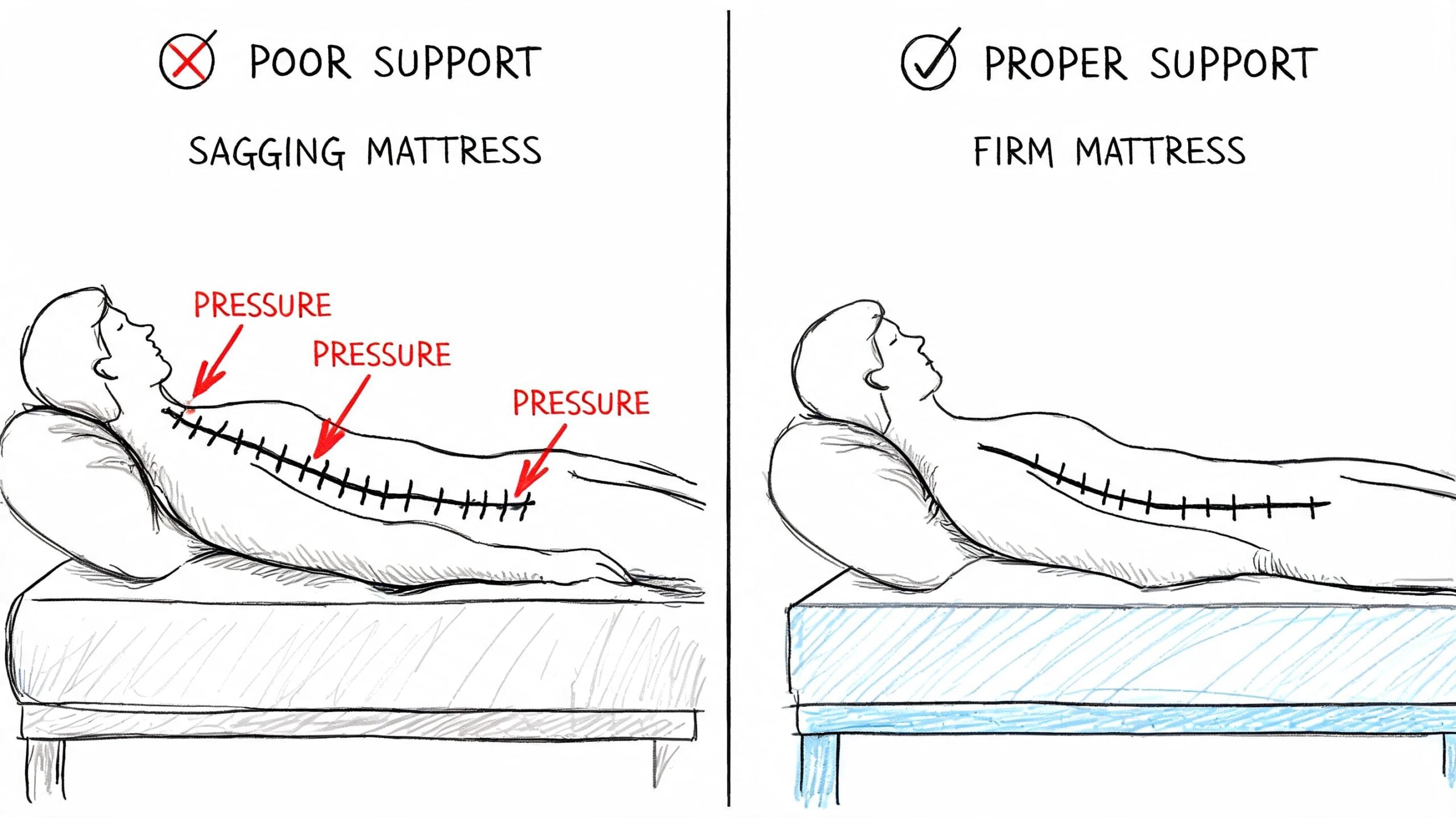
People often focus on comfort first. Comfort matters, but support is what usually makes or breaks your morning. A mattress can feel cozy for ten minutes and still be the reason your back hurts after sleeping.
Clinical guidance regularly points to mattress support as a major factor. The Better Sleep Council recommends replacing a mattress after about seven years because older mattresses lose support over time, according to Advanced Spine Center's summary on waking up with back pain.
Too soft and too firm can both be a problem
Many shoppers get tripped up on this point. They've heard firm is good for a bad back, so they assume firmer is always better. It isn't.
A mattress that's too soft can let the heavier parts of your body sink too far. When that happens, the spine can bow out of a more natural line. On the other hand, a mattress that's too firm can push back too hard at the shoulders and hips, especially for side sleepers, which can create pressure and throw alignment off in a different way.
Practical rule: Don't judge a mattress by firmness alone. Judge it by whether your spine stays supported without sharp pressure points.
Signs your mattress may be part of the issue
You don't need a lab test to spot some common mattress problems. Start with the plain stuff you can see and feel.
- Visible sagging: If there's a dip where you usually sleep, your body is likely dropping into it too.
- Uneven surface feel: Lumps, hammocking, or edge collapse can all change your posture overnight.
- Pain that improves after you get moving: That can point to overnight positioning and support issues.
- A mattress that's old: Wear adds up, even if the bed still looks passable.
If you're not sure whether age or wear is part of the problem, this guide to signs you need a new mattress can help you check the basics.
Around here, we've always looked at mattresses through a fit, not price lens. Price matters to a household budget, of course. But if a mattress doesn't support your body properly, it's not doing the job, no matter what the tag says. Sleep health comes first.
Adjusting Your Sleep Position for Pain Relief
A mattress is the foundation, but position is the part you can often change tonight. Small adjustments can make a real difference because they change how your spine rests for hours at a time.
Clinical guidance points to morning back pain as a biomechanical issue. Hinge Health's explanation of back pain after sleeping notes that stomach sleeping can flatten the lower back's natural curve, while a pillow between the knees for side sleepers or under the knees for back sleepers can reduce lumbar strain and support more neutral alignment.
What to do if you sleep on your side
Side sleeping works well for many people, but only if the body is stacked fairly evenly. If the top leg drops forward, the pelvis can rotate and tug on the lower back.
Try this:
- Place a pillow between your knees: That helps keep your hips more level.
- Keep your head supported at a comfortable height: Too high or too low can ripple down into the rest of your posture.
- Notice shoulder pressure: If your shoulder feels jammed, your mattress may be too firm for that position.
What to do if you sleep on your back or stomach
Back sleeping is often easier on the spine if the lower back isn't overly arched. A pillow under the knees can help relax that area and reduce strain.
Stomach sleeping is the tough one. Many people love it, but it often asks the lower back and neck to do extra work all night.
A quick comparison makes it easier:
| Sleep position | Main concern | Simple adjustment |
|---|---|---|
| Side | Pelvis twisting | Pillow between knees |
| Back | Lower back arching | Pillow under knees |
| Stomach | Lower back extension and neck rotation | Try transitioning to side sleeping, or use flatter support |
If you're trying to match your position to a better mattress feel, this guide on choosing the right mattress for your sleeping style gives a useful starting point.
If you can't stop stomach sleeping, don't panic. Even reducing how often you do it, or adjusting your pillow setup, may help ease some of the strain.
How to Find the Right Mattress for Your Body and Budget
People often walk into a mattress search looking for one label. Firm. Plush. Memory foam. Hybrid. That's understandable, but it's not the best way to solve morning pain.
Whether the mattress keeps your body aligned while also relieving pressure where you need it is the essential consideration. Guidance on this point is consistent. A firmer feel by itself doesn't guarantee relief. The issue is spinal alignment and pressure distribution, and the right choice depends on sleep position, body weight, and where your pain shows up, as explained in this video discussion on mattress firmness and back pain.
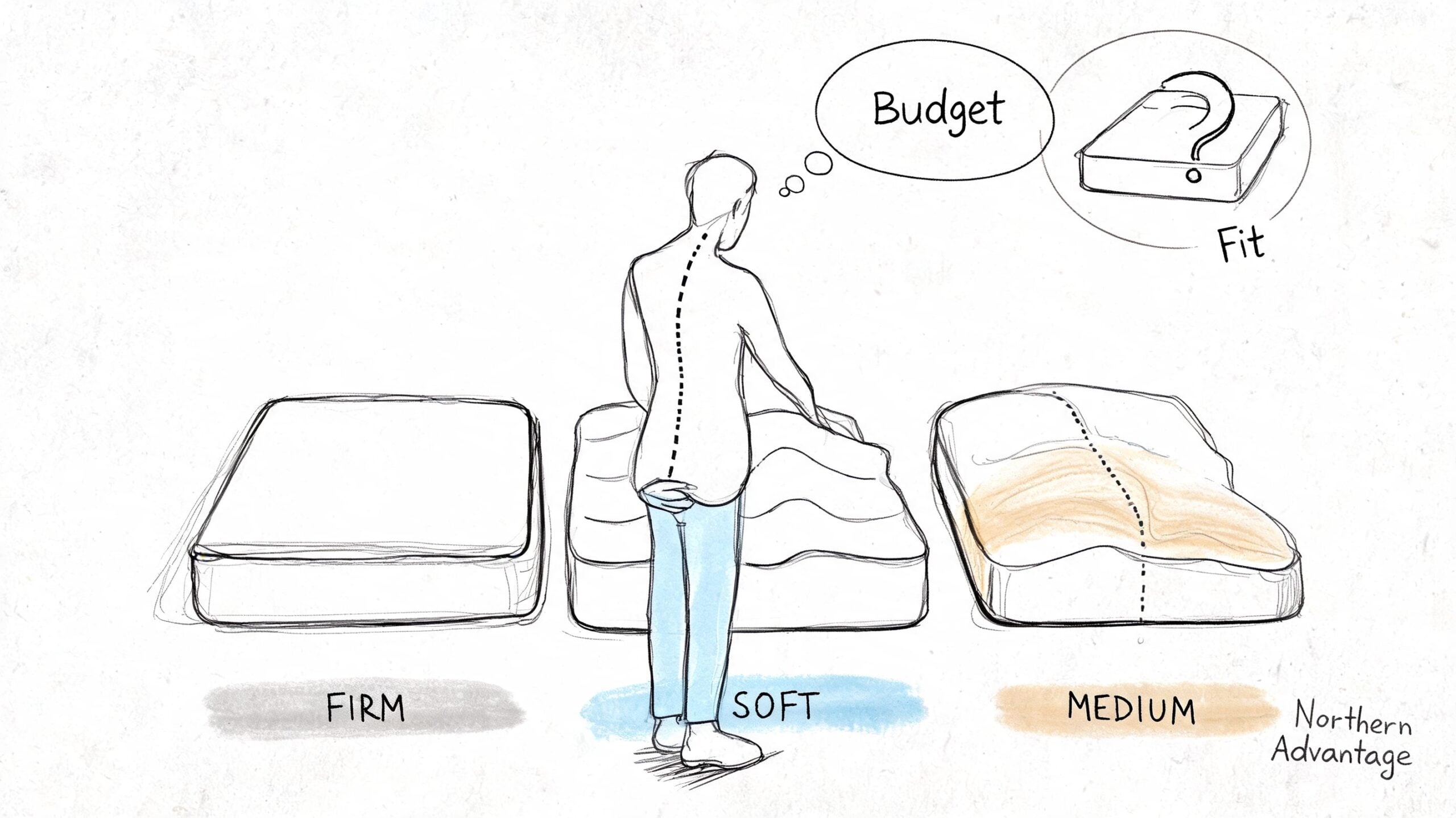
Stop chasing firm and start chasing fit
A lot of confusion clears up when you look at how different surfaces support your body. If you're a side sleeper with pressure at the shoulders and hips, a very firm mattress may feel supportive at first touch but still leave you sore by morning. If you're sleeping on a surface that lets your middle sink too much, softer isn't helping either.
A better fitting process asks questions like these:
- Where is the pain most noticeable? Lower back, upper back, hips, or shoulders can each point to a different mismatch.
- What position do you spend the most time in? Not the position you fall asleep in. The one you keep returning to.
- Do you feel pressure or sagging? Those are different problems and need different fixes.
- What does your pillow do to your neck? Sometimes the mattress gets blamed for a setup problem that starts higher up.
What a good fitting process should include
If you're shopping in person, don't settle for lying on a bed for a few seconds and guessing. Spend enough time to notice whether your shoulders settle naturally, whether your hips feel supported, and whether your lower back feels held up instead of strained.
In Central Maine, many households also have to balance comfort with real-world budget concerns. That's where it helps to work with a store that treats sleep as a fitting process, not a pressure sale. Northern Mattress & Furniture 1st has served Augusta, Skowhegan, and the surrounding area as a third-generation family business since 1950, and their approach includes right-fit guidance, Real Sale Prices through the Price Chop promise, custom order options beyond the floor, and simple financing through the Nest Credit Card with pre-qualification that doesn't impact your credit score.
A useful shopping checklist looks like this:
- Support first: Your spine should feel level and held up.
- Pressure relief second: Hips and shoulders shouldn't feel jammed.
- Position match: Side, back, and combination sleepers need different balance points.
- Budget fit: The right mattress should fit your body and your household plan.
For a broader look at materials, feels, and fit, browse the ultimate guide for choosing a mattress.
The goal isn't to buy “a mattress.” It's to build a sleep setup that gives your body a better chance to recover overnight.
Long-Term Prevention and When to See a Doctor
Morning back pain often improves when you address the full sleep system. Better support, better positioning, and better habits tend to work together. If one piece is off, the others have to compensate.
Simple habits that can help
You don't always need a dramatic overhaul to make progress. A few steady changes can go a long way.
- Adjust one thing at a time: Change your pillow setup or sleep position first so you can notice what helps.
- Move gently in the morning: A short walk around the house or light stretching can ease overnight stiffness.
- Pay attention to patterns: If you hurt more on one side, after one position, or only in one bed, that's useful information.
- Consider support add-ons thoughtfully: For some sleepers, adjustable bases that can help alleviate health concerns may be worth exploring as part of a broader comfort setup.
When it's time to call a medical professional
A mattress article should never pretend to replace medical care. If your pain is persistent, severe, or comes with symptoms that feel out of the ordinary, it's smart to talk with a doctor.
Pay closer attention if you notice:
- Pain that lasts well beyond the morning
- Numbness or tingling
- Weakness
- Pain that seems to be getting worse instead of better
- Concern that an existing back condition may be involved
That kind of follow-up isn't alarmist. It's just sensible. A good sleep setup can help with many common causes of morning soreness, but it can't diagnose an underlying condition.
If you'd like a little guidance without any hassle, Northern Mattress & Furniture 1st is a practical place to start. You can visit the Augusta or Skowhegan showrooms, look around at your own pace, and get help finding the right fit for your sleep style, comfort needs, and budget. It's a low-pressure way to sort out whether your back pain after sleeping is coming from a mattress mismatch, a positioning issue, or both.