
Blog
Assembled TV Stand: A Central Maine Buyer’s Guide


A lot of Central Maine living rooms reach the same moment. The television is finally in place, the sofa feels right, and then the stand underneath becomes the weak link. Sometimes it's a wobbling flat-pack piece with one stubborn door. Sometimes it's still sitting in a box because nobody wants to spend a Saturday sorting hardware on the floor.
That's where an assembled TV stand starts to make sense. For many households, the appeal isn't fancy language or showroom styling. It's simpler than that. A stand that arrives ready to use can save time, reduce setup stress, and feel more solid day after day.
For families settling in for a long season at home, renters trying to make a small apartment feel pulled together, and homeowners upgrading a media room, the right piece does more than hold a screen. It helps make the room feel finished.
Table of Contents
- Making Your House a Home in Central Maine
- What Is a Factory Assembled TV Stand
- How to Choose the Right Assembled TV Stand
- Assembled vs. Flat-Pack: A Practical Comparison
- The Northern Advantage for Maine Shoppers
- Long-Term Care and Safety for Your Investment
Making Your House a Home in Central Maine
As the weather shifts in Central Maine, living rooms start doing more work. They become movie rooms, homework stations, game-day spaces, and the place where everyone lands as the day draws to a close. A TV stand may sound like a small detail, but it often decides whether that room feels calm and settled or cluttered and half-finished.
That's especially true in older homes around Augusta, Skowhegan, and the surrounding towns, where layouts aren't always simple. One family may have a narrow wall between windows. Another may be dealing with a slightly uneven floor. A third may be trying to fit a larger television into a room that was built long before oversized screens became normal.
In those homes, self-assembly can turn into a headache fast. A panel goes in backward. A cam lock doesn't tighten fully. The whole stand looks fine at first, but months later it starts to sway when someone brushes past it.
A living room piece gets used every day. Small assembly mistakes don't stay small for long.
That's one reason so many shoppers end up looking at an assembled TV stand. The value isn't only convenience. It's the feeling of bringing home a piece that already has its structure set, its finish intact, and its job clearly defined.
For a third-generation family business serving Central Maine since 1950, that difference is easy to recognize. People aren't just furnishing a room. They're investing in a house they want to feel like home, whether they've lived there for twenty years or just got the keys last month.
Why this matters in real homes
A sturdy TV stand helps with more than the television itself. It can support game consoles, streaming boxes, sound equipment, baskets, books, and the usual collection of remotes and cords that gather around a screen.
A well-chosen piece also helps the room look settled:
- It grounds the wall so the TV doesn't seem like it's floating awkwardly.
- It hides some clutter behind doors or inside drawers.
- It gives the room weight so the seating area feels intentional.
- It cuts frustration later because there's less fixing, tightening, and adjusting.
That practical side matters in Maine homes, where furniture often needs to last through moves, seasons, kids, pets, and plenty of ordinary wear.
What Is a Factory Assembled TV Stand
An assembled TV stand is a stand that's built by furniture professionals before it reaches the home. Instead of arriving as a stack of panels and bags of hardware, it arrives already put together or nearly ready for placement. In plain terms, it's the difference between a finished loaf from the bakery and a box of ingredients on the counter.
That difference matters more than many shoppers expect. A factory assembled piece is typically squared up in a controlled setting, with the joints tightened correctly and the finish protected through the build process. The customer doesn't have to worry about whether one side is slightly off, whether a shelf was installed backward, or whether the hardware was seated unevenly.
Why shoppers choose assembled
The first reason is simple. It saves effort. Homewyse estimated the basic cost to assemble one TV stand at $171–$430 per stand in January 2026. That makes assembly a meaningful part of the purchase decision, not a minor add-on. For many households, an assembled piece already includes value that would otherwise show up as extra labor, extra time, or extra aggravation.
The second reason is consistency. A stand built ahead of time usually arrives looking the way it was intended to look. Doors tend to sit straighter. Drawers tend to line up better. Corners usually feel tighter.
Practical rule: If a household wants furniture that can be placed, styled, and used the same day, an assembled TV stand is often the simplest path.
How it differs from flat-pack
Flat-pack furniture has its place. It can be easier to move in parts, and some shoppers enjoy the lower-upfront, do-it-yourself route. But the customer becomes the assembler, troubleshooter, and quality-control department.
With factory assembly, those tasks are handled before the stand reaches the home. That doesn't mean every assembled piece is automatically right for every room. It does mean the customer starts from a stronger baseline.
For anyone trying to compare materials, dimensions, finishes, and storage details without getting lost in furniture jargon, this guide on how to read furniture product descriptions and buy with confidence can make the shopping process much clearer.
How to Choose the Right Assembled TV Stand
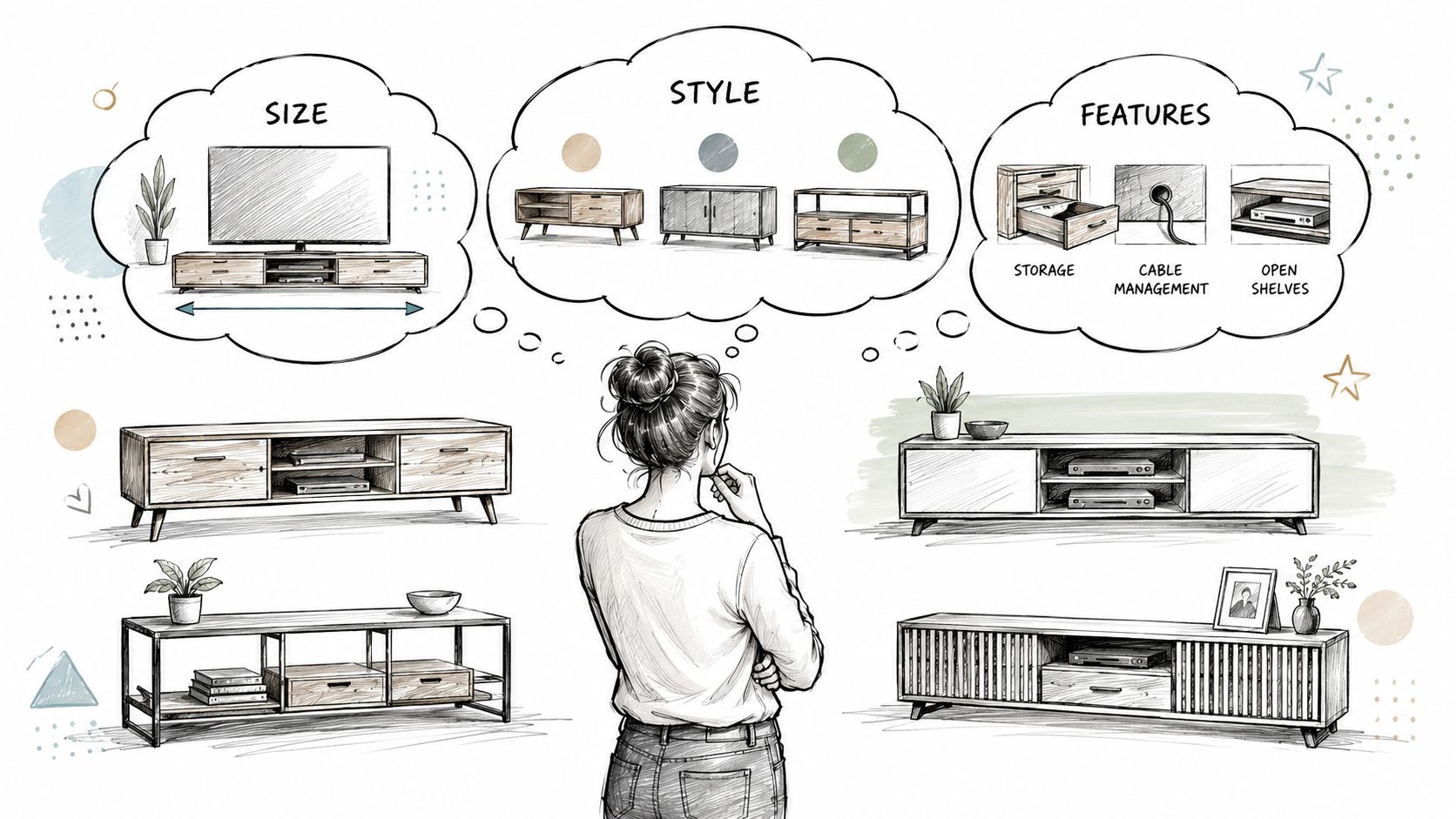
A good TV stand choice usually gets clearer once the room is measured and the household routine is considered. Around Central Maine, that matters more than many online guides let on. A stand may look right on a screen, then arrive too deep for a smaller living room, too tall for comfortable viewing, or too light-duty for a heavier television and a stack of electronics.
Start with fit, not finish
Color and style catch the eye first. Fit decides whether the piece works.
The stand should be wider than the television so the setup feels balanced and the base has proper support. Exact sizing depends on the TV's pedestal or feet, but a little extra width on each side usually gives the room a steadier, less crowded look. If you are shopping in person or ordering for delivery in Central Maine, bring the full TV width and the distance between the feet, not just the screen size. That one step prevents a lot of expensive guesswork.
It helps to measure four things before buying:
- Wall width, so the stand does not crowd windows, heat registers, or trim
- Walking space, especially in narrower rooms or open kitchen-living layouts
- Viewing height, so the screen feels comfortable from the main seat
- Depth from the wall, including baseboards, cords, and outlet clearance
A TV stand works a lot like a woodstove hearth pad. If the footprint is wrong, the whole setup feels off no matter how nice the finish looks.
Check what the stand needs to carry
Many shoppers get tripped up by focusing on the television and forgetting everything else that ends up living on or inside the stand.
A real setup might include a soundbar, modem, game console, streaming box, and a basket of remotes or charging cords. Some homes also need room for board games, kids' items, or speakers. Before choosing a piece, look at the listed weight capacity for the top and shelves, and pay attention to how the stand is built. Solid joinery, thicker tops, and stable framing usually matter more over time than decorative details.
A simple checklist helps:
| What to check | Why it matters |
|---|---|
| Top weight capacity | Supports the television without strain |
| Shelf strength | Prevents sagging under electronics or storage bins |
| Back panel or cord openings | Keeps wiring manageable and easier to access |
| Leg or base design | Affects steadiness on uneven floors |
| Interior shelf size | Makes sure devices actually fit behind doors or inside cubbies |
If a product description feels vague, slow down and ask questions before ordering. That matters even more with custom ordering, where the right dimensions and storage layout can save years of annoyance.
Match the stand to daily use
The best choice depends on how the room functions every day.
Open shelves are often helpful for households that use consoles or audio gear that need airflow. Closed storage suits rooms where people want a calmer look and fewer visible cords. In a smaller Maine camp, apartment, or farmhouse living room, a lower-profile stand can keep the room from feeling boxed in. In a larger family room, a wider piece often looks more settled and gives better storage balance.
Pets and children matter too. So does mud season. A stand with easy-to-clean surfaces, steady doors, and fewer delicate edges tends to age better in a busy home than one chosen only for a trendy look.
Consider delivery, stairs, and the real setup at home
This practical part gets overlooked online. In Central Maine, the right stand on paper can still be the wrong stand if it will not make it through the entry, around a tight corner, or down a staircase.
Measure the path into the house, not just the wall where the furniture will sit. For assembled furniture, outside dimensions matter from the driveway to the living room. That is one reason in-home delivery can be so helpful locally. It takes some of the risk out of buying a larger, fully built piece, and it gives shoppers a clearer picture of the total cost instead of finding surprise setup expenses later.
If you want a broader local checklist before deciding, this guide on how to shop for TV stands is a useful next step.
A well-chosen assembled TV stand should fit the room, carry the load, and make daily life easier. That is the standard to use.
Assembled vs. Flat-Pack: A Practical Comparison
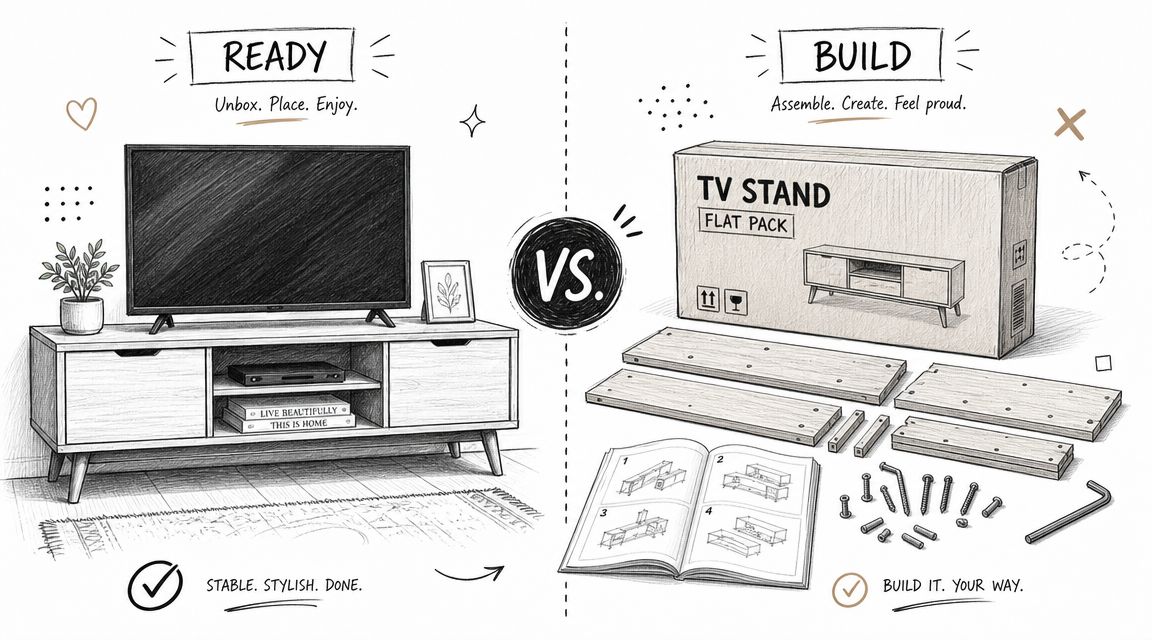
A lot of Central Maine shoppers end up choosing between two very different paths. One is a TV stand that arrives built and ready to place. The other is a box of parts, hardware, and instructions waiting on the living room floor. Neither choice is wrong. The better fit depends on how you live, how long you plan to keep the piece, and how much work you want to do after it gets home.

Where assembled furniture earns its keep
An assembled TV stand usually has one clear strength. It starts life square, tight, and ready for daily use.
That matters more than it may seem online. A TV stand works a bit like a small bridge in your living room. It has to hold weight evenly, keep its shape, and stay steady when drawers and doors are used over and over. If the joints are slightly off during home assembly, the stand may still look fine on day one, but small problems can show up later as wobble, sticking doors, or shelves that no longer sit level.
In a busy Maine household, those small issues tend to show up faster. Floors are not always perfectly even. Heating seasons dry materials out. Kids, pets, and everyday cleaning all put a little stress on the piece. A factory assembled stand often handles that routine better because the joints were fitted correctly from the start.
For buyers who want furniture to stay put for years, that kind of steadiness has real value.
When flat-pack is still the better fit
Flat-pack can be the sensible choice in the right situation. If you rent, move often, or need to carry furniture into a tight space in pieces, a boxed stand can solve a practical problem that a fully assembled one cannot.
It also gives some households more flexibility on the front end. The carton is easier to transport, easier to store for a short time, and sometimes easier to work into a camp, upstairs room, or temporary setup.
The trade-off is time and tolerance. Someone still has to sort the hardware, follow the steps in order, keep everything aligned, and tighten it correctly without damaging the panels. If one early step is off, the whole unit can end up slightly twisted.
That does not make flat-pack poor quality by default. It means the final result depends much more on the person doing the assembly.
What this choice looks like in everyday Maine homes
Here is the plain-language version.
- Assembled stands usually make more sense for long-term use, heavier electronics, and family rooms where the piece needs to stay solid.
- Flat-pack stands often make more sense for short-term living arrangements, lighter loads, or homes where moving the furniture in separate pieces is the main concern.
- Assembled furniture asks more from the seller and delivery team.
- Flat-pack furniture asks more from the buyer.
That last point is the one many national articles skip. In Central Maine, the decision is not only about the stand itself. It is also about whether local services make the assembled option practical. If a store offers free furniture delivery for qualifying purchases, a fully built TV stand becomes much easier to choose because you are not left figuring out transport, lifting, and setup costs on your own.
Some neighbors want a stand they can carry in a hatchback and build on a Saturday. Others want one solid piece delivered into place so they can use it that night. Both are reasonable. The better choice is the one that matches your home, your time, and how long you expect the furniture to serve you.
The Northern Advantage for Maine Shoppers
TV stands are not a fringe product category. The global Entertainment Centers and TV Stands Market was valued at USD 3.33 billion in 2025, according to this market overview. That matters because it reflects how central these pieces remain in real homes. They're not just decorative extras. They're core living-room furniture.
For Maine shoppers, that big-picture category only matters if the local buying experience solves local problems. Large furniture needs to fit the room, get through the door, and match the home. A good purchase also needs to work with the household budget.

Local help matters with large furniture
Central Maine homes aren't all built alike. Some have tighter entries. Some have older staircases. Some have open-concept layouts that need a longer, lower stand to look right. That's where local showroom guidance can be more useful than generic online advice.
Northern Mattress & Furniture 1st serves Augusta and Skowhegan with assembled entertainment furniture, in-home delivery, and a no-hassle showroom setting. For many shoppers, that means they can focus on fit, finish, and function instead of figuring out how to transport a large piece on their own.
The store's approach also leans into practical value:
- Price Chop promise helps shoppers look for real sale prices rather than inflated markdown games.
- Simple financing through the Nest Credit Card lets customers pre-qualify without a credit score impact.
- Showroom support gives families a chance to compare sizes, storage layouts, and finishes in person.
- Complimentary coffee and bottled water make the visit feel relaxed, not rushed.
More choices than the floor model
One common misunderstanding is that the shopper must buy only what's sitting on the floor. That's rarely the whole story. Custom ordering can make a major difference when the room needs a certain width, finish, or style direction.
That's especially useful for buyers who want to coordinate a TV stand with existing living room pieces or build around a certain look. Some shoppers want a cleaner modern profile. Others want warmer wood tones that feel more at home in a traditional Maine interior.
For anyone who needs more flexibility than the showroom floor alone can offer, custom furniture options near Central Maine can open up more styles, fabrics, and configurations.
A good local furniture experience doesn't just answer, “What's in stock?” It also answers, “What will actually work in this house?”
Long-Term Care and Safety for Your Investment
Once the stand is in place, a little routine care goes a long way. Most assembled TV stands don't need complicated maintenance. They need steady habits.
Simple upkeep that helps furniture last
Dust with a soft cloth. Clean spills promptly. Don't let moisture sit on the surface longer than necessary, especially around seams and edges. If the piece has a wood-look or wood surface, everyday protection matters more than aggressive polishing.
For broader care tips, this guide on protecting wood furniture from scratches and stains is worth bookmarking.
A few habits help keep the stand looking good:
- Use light, regular cleaning instead of harsh products.
- Avoid overloading shelves with heavy items that weren't part of the original plan.
- Recheck level placement if the floor is uneven or rugs shift underneath.
- Keep heat sources in mind so finishes aren't stressed unnecessarily.
Safety matters more than styling
Safety should never be treated as optional, especially in homes with children or pets. For wall-mounted or floating styles, secure installation into studs with the recommended hardware is critical. For masonry, properly rated masonry anchors are necessary. The safe load is only as strong as the weakest point in that chain.
Even with floor-standing pieces, homeowners should total the weight of the TV, components, and stored items, then stay comfortably below the published capacity. A stand that looks stable can still be overloaded.
The safest room is the one that works in the background. No wobble. No tipping risk. No constant need for adjustment.
A well-chosen assembled TV stand can make daily life easier, especially when the goal is comfort, durability, and a room that feels finished for the long haul. For anyone comparing options in person, exploring custom-order possibilities, or looking for a no-pressure shopping trip, Northern Mattress & Furniture 1st welcomes visitors to the Augusta or Skowhegan showrooms with a relaxed atmosphere, practical guidance, and the kind of local help that makes it easier to find the right fit for home.