Blog
Living Room Furniture Layout Ideas: Expert Guide 2026

The room usually tells on itself.
You can see it when the sofa is pushed flat against the wall, the chairs don’t quite relate to each other, and everyone still ends up standing in the kitchen during a get-together. Other times the problem is the opposite. You’ve just moved into a new place in Central Maine, the walls are bare, and the living room feels like a blank box with no clear answer.
That’s where good living room furniture layout ideas matter. A strong layout doesn’t just make a room look better. It makes the room easier to live in on a cold weeknight, during a Sunday football game, or when grandparents, kids, and neighbors all end up in the same space at once. In many Maine homes, that kind of flexibility isn’t a bonus. It’s the job.
Table of Contents
- Making Your Maine House a Home
- Start with a Plan Before You Move a Thing
- Create Pathways and Conversation Zones
- Layout Examples for Common Room Shapes
- Adding the Finishing Touches That Feel Like You
- Your Partner in Making Your House a Home
Making Your Maine House a Home
A lot of living rooms in Central Maine have to do more than one job. They’re TV room, reading room, holiday gathering spot, and sometimes a quiet place for someone to rest in the afternoon. In older homes around Augusta, Skowhegan, and the surrounding towns, the layout challenge often isn’t style. It’s making a room work for real life.
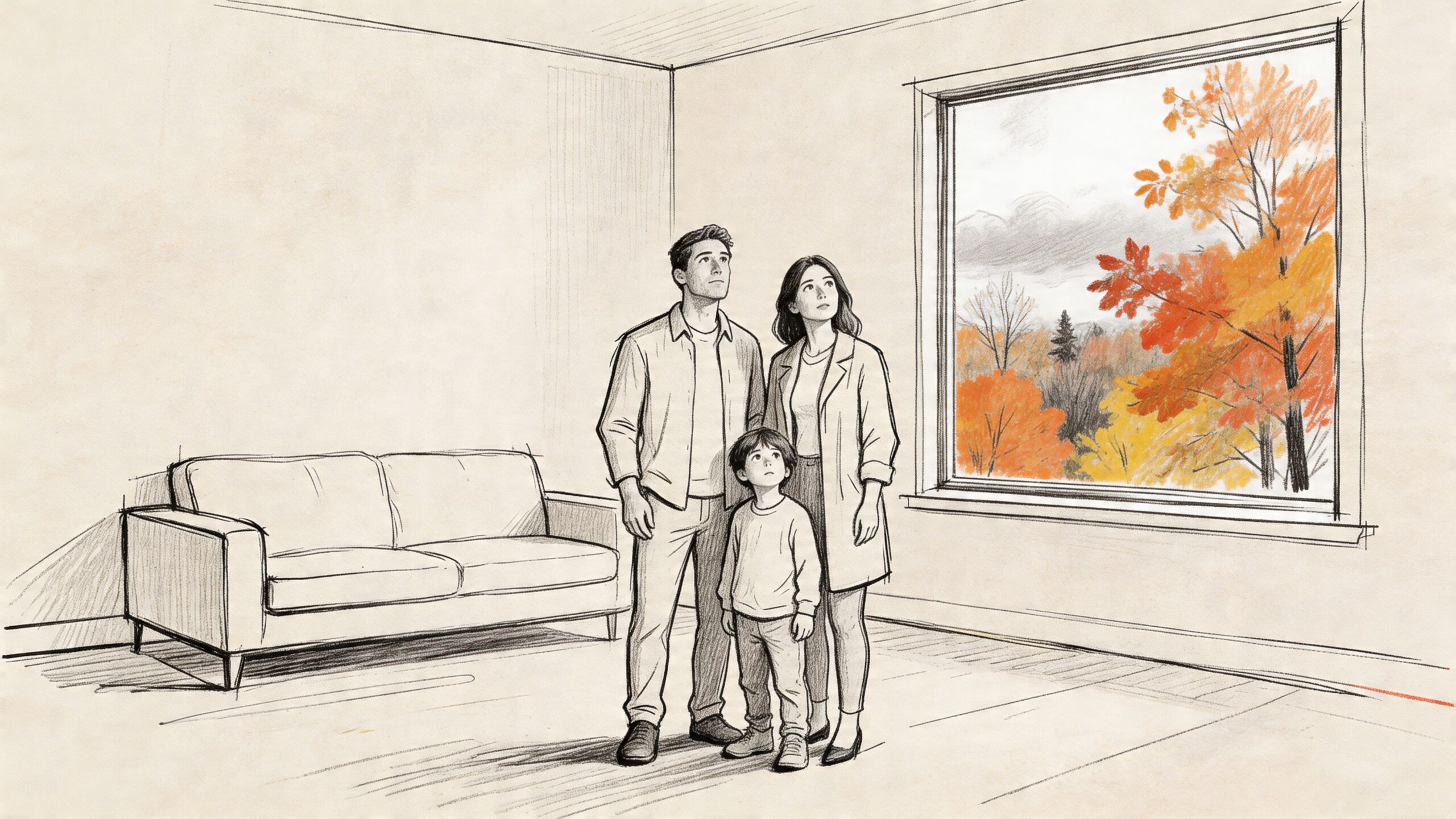
One family might need a clear path for a grandparent using a walker. Another needs a play zone that doesn’t swallow the whole room. Another has a long wall, a woodstove, and no obvious place for the sofa. Those are normal Maine-house problems. They don’t mean the room is bad. They mean the layout needs some thought.
Existing design content often skips over the homes where multiple generations share space, even though 25% of Maine households include three generations according to the angle highlighted in this discussion of awkward living room ideas. That’s one reason modular seating and custom-fit arrangements matter so much in this region. A layout has to welcome people of different ages and mobility needs without feeling clinical.
A room should support the way your family gathers
The best rooms don’t feel staged. They feel settled.
In a good layout, people know where to sit, where to walk, and where to put a cup of coffee without asking.
That usually means thinking beyond the floor model look. A loveseat that’s too short, a sectional that blocks a path, or a chair that’s beautiful but awkward in daily use can all make a room feel harder than it needs to be. Durable pieces from lines like Flexsteel tend to work well when the room gets used every day, especially when the seating plan needs to flex for family visits or seasonal changes.
A practical first step is gathering inspiration that reflects how you live, not just what photographs well. A solid starting point is this collection of living room essentials and design ideas, especially if you’re trying to sort out what the room is missing before you start moving furniture around.
Common Maine-house layout pressures
- Older floor plans: Doorways, radiators, and off-center windows can limit obvious furniture placement.
- Multi-use rooms: The living room may also handle homework, naps, or overflow guests.
- Seasonal living: In winter, people naturally gather closer together, so comfort and circulation both matter.
Start with a Plan Before You Move a Thing
Most layout mistakes happen before a single piece is moved. People guess. They eyeball the wall. They assume the coffee table they like online will work with the sofa they already own. Then the room feels cramped, disconnected, or oddly empty.
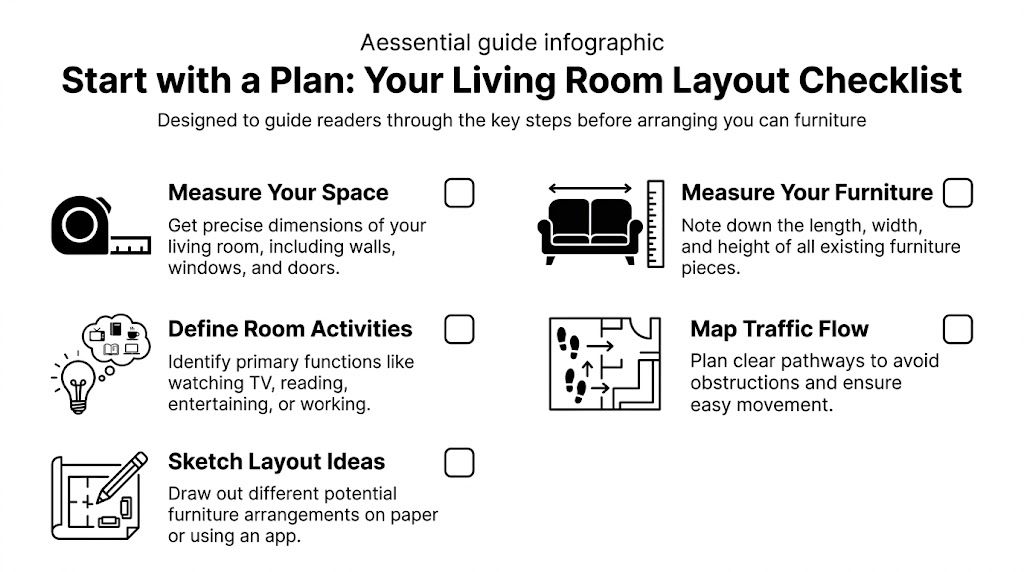
The fix is simple. Measure first, sketch second, move last.
What to measure before anything else
Start with the room itself. Measure each wall, then mark where windows, doors, floor vents, radiators, and outlets fall. After that, measure the furniture you already have and want to keep. Include width, depth, and height, because visual weight matters almost as much as footprint.
A graph-paper sketch works fine. So does painter’s tape on the floor if you’re more visual.
Use this quick checklist:
- Room dimensions: Note the full shape, not just the longest walls.
- Obstacles: Include door swing, trim, hearth depth, and traffic pinch points.
- Furniture size: Measure every major piece, especially sofas, sectionals, recliners, and tables.
- Function: Decide if the room is mainly for conversation, TV viewing, reading, or a mix.
- Traffic flow: Mark the natural paths people already take.
If you need help with the practical side, this guide on how to measure furniture before delivery is worth reviewing before you commit to a piece that looks right in the showroom but won’t work in the house.
Use the 2 thirds rule to control scale
One of the best tools for living room furniture layout ideas is the 2/3’s rule. Designers use it to keep supporting pieces in proportion to the anchor piece, usually the sofa. According to JL Coates’ explanation of the 2/3’s rule, a coffee table should be roughly 2/3 the length of the sofa, and an area rug should cover at least 2/3 of the main seating footprint. The same source notes that following this guideline can reduce layout rework by up to 50%.
That sounds technical, but it’s easy in practice. If the sofa is long and grounded, the coffee table should have enough presence to hold the center. If the rug is too small, every piece looks like it’s drifting.
Practical rule: When a room feels “off” but you can’t explain why, scale is often the problem before color or style is.
A quick scale check
| Piece | What to compare it to | What usually works |
|---|---|---|
| Coffee table | Sofa length | Around 2/3 of the sofa length |
| Artwork | Sofa width | Around 2/3 of the sofa width |
| Rug | Seating group | At least 2/3 of the main seating footprint |
A good plan saves your back, your time, and usually your budget too.
Create Pathways and Conversation Zones
A living room can have beautiful furniture and still fail if people can’t move through it easily. The room has to let someone carry laundry through, bring in snacks, sit down without sidestepping a table, and cross the space without cutting through the middle of a conversation.
That’s why strong layouts start with movement, not decoration.

Find the room’s real focal point
Every room has an anchor, even if it isn’t ideal. Sometimes it’s the fireplace. Sometimes it’s the television. In other homes, it’s the big front window or the spot where everyone naturally looks when they sit down.
Once you identify that anchor, the room starts making more sense. The seating should acknowledge it instead of fighting it. A room with two competing focal points usually works better when one clearly leads and the other supports.
Build the seating around people, not walls
One of the simplest designer rules is the 2:1 principle. As outlined in House Beautiful’s look at the ideal seating arrangement, the idea is two chairs for every one sofa. That setup appears in over 50% of designer-recommended living room layouts, and the same source notes it improves perceived comfort and social engagement.
What matters most isn’t the ratio by itself. It’s what the ratio creates. The chairs and sofa form a conversation triangle. People can make eye contact. The room feels welcoming instead of lined up like a waiting area.
For everyday planning, keep these clearances in mind:
- Main walkways: Leave 30-36 inches where people regularly pass.
- Tight spots: In smaller rooms, 18-24 inches can still work for necessary clearance.
- Conversation distance: Seats placed within 3.5-10 feet of each other tend to feel natural for talking.
Those numbers come from the same verified layout guidance tied to the 2/3’s methodology and designer planning standards. They’re useful because they help you avoid the two most common mistakes: pieces jammed too close together, or furniture spread so far apart that the room stops feeling connected.
Don’t push every piece to the perimeter just because the room is small. A room can look larger and feel better when the furniture relates to itself.
A quick path check that works in real homes
Stand in the doorway and ask three plain questions:
- Can someone cross the room without weaving?
- Does every seat have an easy approach?
- Will conversation still work if one person is watching TV and another is reading?
That last one matters more than people think. A family room has to absorb different moods at the same time. If you entertain often, these design tips for effortless entertaining can help you think through side tables, extra seating, and guest flow before the room gets crowded.
Layout Examples for Common Room Shapes
The best living room furniture layout ideas are the ones you can picture in your own house. Most homes don’t need a dramatic solution. They need a dependable arrangement that respects the shape of the room and the way people use it.
The classic rectangular room
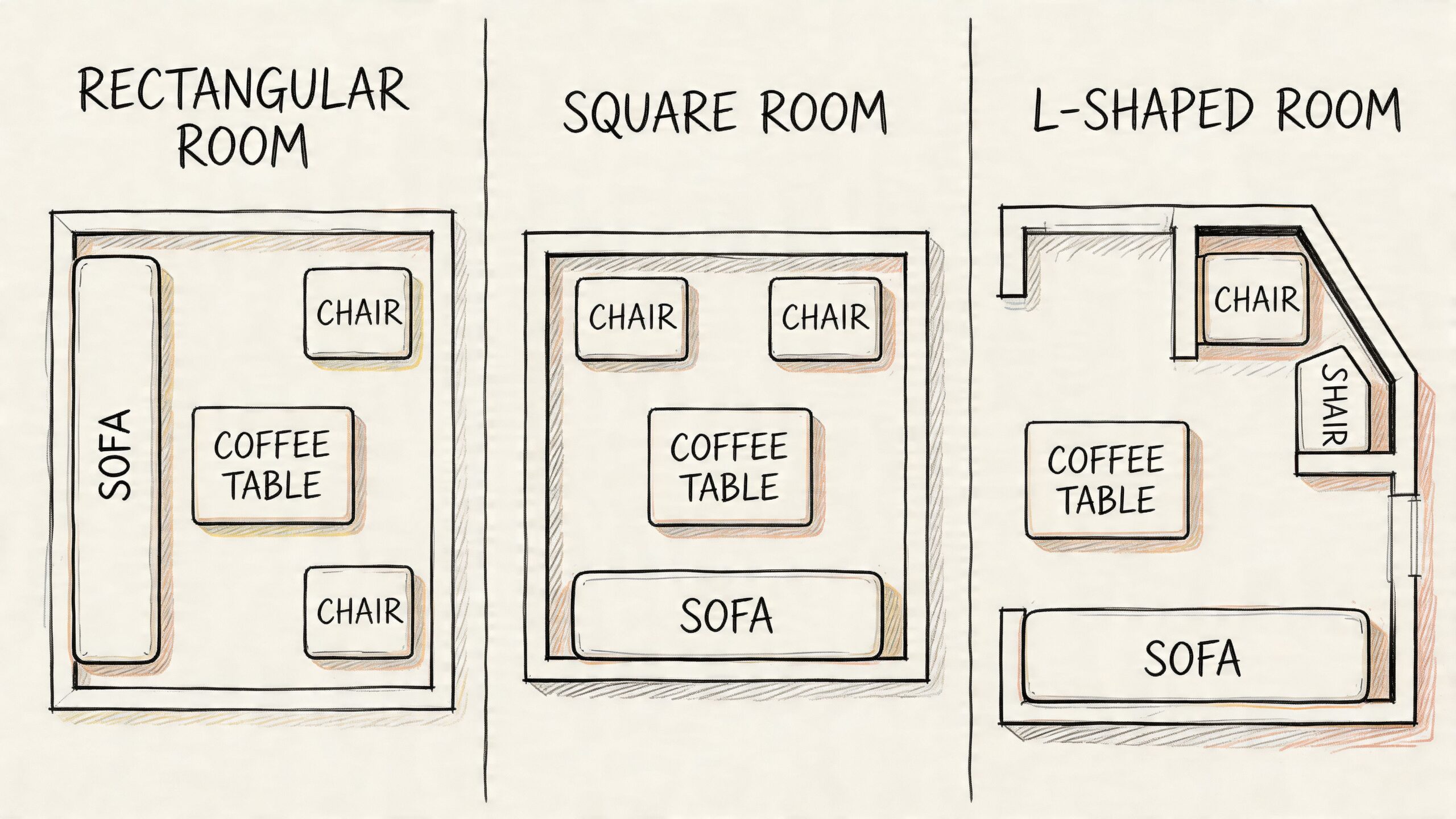
For a standard rectangular living room with one clear focal point, the strongest starting layout is often one sofa, two paired chairs opposite, and one lone accent chair. According to Emily Henderson’s layout guide, this arrangement is ideal for rooms with a single focal point, seats 4-6 people, and appears in over 40% of professionally analyzed living room projects.
That popularity makes sense. It feels complete without being stiff. The paired chairs create order, and the single chair gives you flexibility. In a family home, that lone chair often becomes the reading seat, the knitting seat, or the place someone claims during every holiday visit.
What works:
- Sofa facing the fireplace or TV
- Matching chairs across from it
- One accent chair angled near a corner or side table
What doesn’t:
- Four matching bulky seats
- Too many end tables
- An accent chair shoved in only because there was leftover space
The square room that needs balance
Square rooms can be trickier than long ones because they invite furniture to float in awkward ways. A balanced grouping usually works better than lining every piece against a wall.
Try this approach:
- Put the sofa on the strongest wall
- Face two chairs toward it
- Use a centered rug and coffee table to lock the grouping together
- Keep a perimeter path so people aren’t cutting through the middle
A square room often benefits from furniture with visible legs and moderate scale. Heavy pieces in all four corners can make it feel boxed in.
The open room or awkward footprint
Open-concept rooms and L-shaped spaces need zoning more than symmetry. In those homes, a sectional can do real work if the size and orientation are right. It can separate the living area from dining space without adding clutter.
For angled or less predictable rooms, designers often float the sofa slightly off the wall and let the seating follow the shape of the room. The TV setup matters here too, especially if you’re trying to avoid neck-craning from one side seat. This guide to calculating the best placement for your sofa and television is useful when the room has more than one possible viewing wall.
A sectional fixes a bad room only when it fits the room’s path and purpose. If it blocks movement, it becomes the problem.
Custom-configured pieces can make a major difference in these layouts because the right length, chaise direction, or seat depth often matters more than the style name on the tag.
Adding the Finishing Touches That Feel Like You
A room isn’t finished when the big furniture lands in the right place. It’s finished when the space starts feeling like the people who live there. That shift usually comes from color, lighting, texture, and the smaller choices that soften the room.
A good layout makes the room functional. The finishing layer makes it personal.
Color keeps the room calm
For difficult rooms, especially ones with odd angles or visual interruptions, the 60-30-10 color rule is one of the easiest ways to bring order. As explained in this design expert piece on angled room layouts, designers use 60% dominant neutral on large surfaces such as walls, rugs, and sofas, 30% secondary color on chairs or lamps, and 10% accent color in art, pillows, or lighting.
That’s useful because it keeps the room from arguing with itself. If the walls angle, the windows are off-center, or the architecture feels busy, a quiet base helps the room settle down. Then you can add personality without making the space feel noisy.
A practical version might look like this:
- 60 percent base: warm beige walls, neutral rug, and a sofa in a grounded fabric
- 30 percent support: blue-gray chairs, wood tones, or darker window treatments
- 10 percent accent: rust pillows, black metal lamps, or artwork with a little contrast
The small pieces do the emotional work
Lighting is one of the biggest difference-makers in a living room. Overhead light alone rarely carries the room well. A better mix is ambient light from a ceiling fixture, task light near a reading chair, and softer accent light from lamps.
The rug matters too. It shouldn’t feel like an afterthought. It should visually hold the seating group together and add some warmth underfoot, especially during Maine’s colder months.
A few finishing moves that usually help:
- Add texture: Mix leather, wood, woven fabric, and softer textiles so the room doesn’t feel flat.
- Use side tables selectively: Every seat doesn’t need its own table.
- Choose art by scale first: The wrong size artwork can undo an otherwise strong wall.
For more practical room-lighting ideas, this article on putting your living room in the best light is a helpful companion when the layout is done but the room still feels incomplete.
Customization belongs here too. Sometimes the right answer isn’t a different layout. It’s the right fabric, the right arm style, or the right shade on one accent piece that finally makes the room feel like home.
Your Partner in Making Your House a Home
A living room comes together best when the layout, the furniture scale, and the daily habits of the household all line up. That sounds simple, but it’s where many people get stuck. The room may need a narrower sofa, a better sectional configuration, a sturdier chair, or a fabric that stands up to kids, pets, and everyday use.
What to do when the room fights back
Some rooms resist standard answers. Older Maine homes can have tight entries, sloped walls, off-center fireplaces, or traffic patterns that cut right through the seating area. That’s when it helps to stop shopping by silhouette alone.
Look for pieces based on:
- Durability: Daily-use seating needs strong construction and fabrics that wear well.
- Fit: The right depth, width, and arm shape can solve more layout problems than a trendy style can.
- Flexibility: Sectionals, benches, swivel chairs, and movable ottomans give the room options.
If a floor sample is close but not quite right, custom ordering can be the difference between “good enough” and a room that works. That’s especially true when you need a specific configuration, fabric, or finish to suit your space.
Why local guidance still matters
In Central Maine, people tend to furnish with the long haul in mind. They want a house to feel lived in, comfortable, and ready for company. They also want to avoid buying twice.
That’s why a local, experienced furniture team still matters. A third-generation family business that’s served this region since 1950 understands the kinds of rooms people here live with, from in-town capes to larger rural homes built for extended family life. It also helps to have a no-hassle showroom experience where you can sit in the pieces, compare cushion feel, ask practical questions, and take your time.
If budget is part of the equation, the best approach is straightforward value. Real sale pricing matters. So does simple financing that lets shoppers plan responsibly, including the ability to pre-qualify for the Nest Credit Card without a credit score impact. And when the right piece isn’t on the floor, custom order options from respected names like Flexsteel and Ashley can open up far better answers than settling for something that only half works.
If you’re ready to turn ideas into a room that fits your home, visit Northern Mattress & Furniture 1st in Augusta or Skowhegan. You’ll find a no-hassle showroom, durable furniture for real Maine living, custom order options, the Price Chop promise with real sale prices, and simple financing through the Nest Credit Card. Stop in for a look, a conversation, and even a complimentary coffee or bottled water while you figure out the right fit for your living room.