Blog
Stylish Small Space Dining Solutions


A lot of small space dining problems start the same way. Someone finds a table they like, checks that it technically fits the room, brings it home, and then realizes nobody can slide a chair back without bumping a wall, a radiator, or the path to the kitchen.
That's especially common in Central Maine homes, where dining areas often have to do more than one job. A breakfast nook in Augusta might double as homework central. A compact dining corner in Skowhegan might also be the place where mail lands, laptops open, and weekend guests squeeze in for coffee. Good small space dining isn't about forcing a full dining room into a tight footprint. It's about making the space work for the way your household lives.
Table of Contents
- Starting Your Small Space Dining Plan in Maine
- How to Plan Your Dining Layout with Confidence
- Choosing the Right Dining Furniture for Your Home
- Smart Storage and Lighting Solutions
- Styling Tricks to Make the Space Feel Bigger
- The Northern Advantage for Your Maine Home
Starting Your Small Space Dining Plan in Maine
In many Maine homes, the dining area isn't a formal room you use a few times a year. It's part of the everyday rhythm of the house. It handles rushed breakfasts before work, weeknight meals, school projects, puzzle time, and the extra seat someone always needs when company drops by.
That's why the first question isn't, “What table will fit?” It's, “What does this area need to do most days?” The most overlooked part of small space dining planning is understanding how much dining space your household needs for its routine, whether that means daily meals, homework, or occasional guests, as noted in this lifestyle-first planning guidance.
Start with use before size
A dining nook used twice a day needs something different than one used mainly for holidays or weekend visitors. If your household eats every meal there, comfort matters more. If the table also serves as a laptop station, chair support and surface durability matter just as much as looks.
A helpful way to sort this out is to write down what happens there in a normal week:
- Daily meals: You need dependable seating, easy movement, and a surface that's simple to wipe down.
- Homework or laptop work: Prioritize chair comfort, good lighting, and enough tabletop space for more than plates.
- Occasional guests: Flexibility matters more than a large everyday footprint.
- Multipurpose living: Consider whether the dining area must visually blend with a nearby kitchen or living room.
Small space dining works better when you plan for your busiest ordinary day, not your biggest holiday.
If you're still sorting out the basics, this guide to designing a dining room from the ground up is a useful next read. It helps narrow your priorities before you get attached to a specific set.
How to Plan Your Dining Layout with Confidence
Most layout mistakes happen before anyone shops. The room may look open when it's empty, but once chairs are occupied and people need to pass through, the pressure points show up fast.
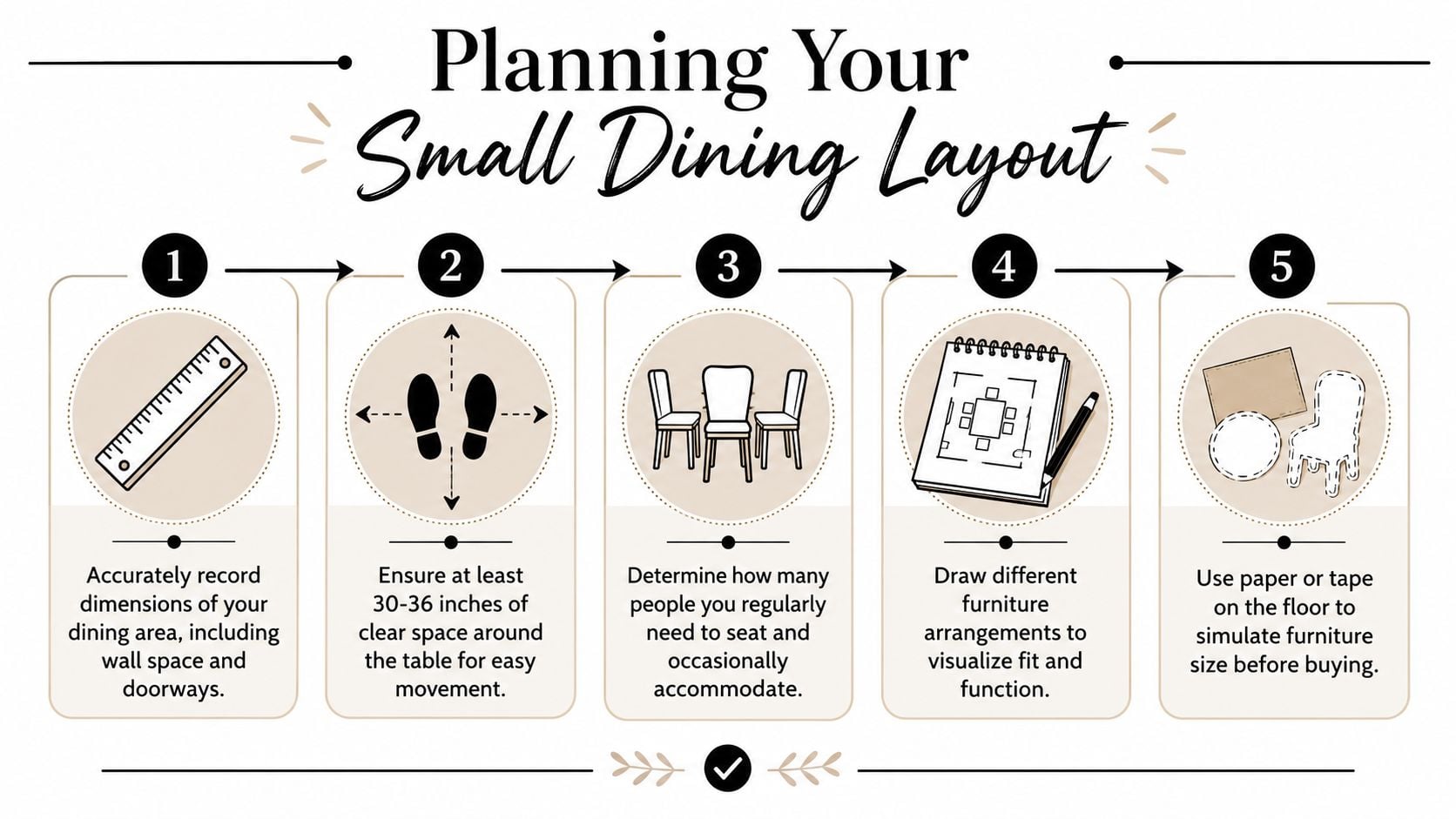
Professional planning starts with circulation first. Guidance from Houzz recommends at least 36 inches of clear space around a table so people can pass comfortably, with 30 inches sometimes workable in tighter spots, as explained in this dining room measurement guide.
Measure the envelope, not just the room
Don't stop at wall-to-wall dimensions. What matters is the usable furniture envelope after you account for movement around the table. That means doors that swing open, traffic to the fridge, and the space a chair uses when someone is sitting in it.
A practical measuring routine looks like this:
- Measure the full room or dining zone.
- Mark walkways and natural paths people use every day.
- Subtract the clearance your layout needs around the table.
- Only then start looking at table shapes and seating.
Forethought often saves buyers a return trip. A table can fit the room on paper and still fail in real life if it blocks the path between the kitchen and living room.
Room shape should guide table shape
Square and round tables usually sit more naturally in square rooms. Rectangular and oval tables tend to work better in long, narrow areas. That isn't just a style issue. It affects how people move through the space and where chairs land when pulled out.
Here's a simple planning reference:
| Room condition | Usually works well | Often causes trouble |
|---|---|---|
| Square nook | Round or square table | Long rectangular table |
| Narrow dining strip | Rectangular or oval table | Wide round table that pinches walkways |
| Open-plan corner | Pedestal base table, bench on one side | Bulky chair backs in all directions |
Practical rule: Tape the footprint on the floor before buying. It's the fastest way to find out whether a layout feels comfortable or cramped.
If you need help getting accurate dimensions before you shop, use this guide on how to measure furniture for your home. It's much easier to adjust a plan with a tape measure than after delivery day.
Choosing the Right Dining Furniture for Your Home
Once the layout is settled, the furniture choices get easier. You're no longer asking what looks good in a showroom. You're asking what works inside the footprint your room can support.
In compact homes, the wrong table base can be just as frustrating as the wrong tabletop shape. Thick legs, oversized aprons, and deep chair backs often steal more usable room than people expect.
When round tables make sense
Round tables remain a classic small space dining solution because they remove corners and can seat more people in a compact footprint. Pottery Barn's guidance also recommends pedestal bases so table legs don't interfere with seating, which is especially helpful in tighter layouts, as described in this small dining space guide.
That combination works well in real homes for a few reasons:
- Softer traffic flow: No sharp corners jutting into a walkway.
- More forgiving seating: People can shift around more easily when there are no legs at each corner.
- Better for conversation: Everyone faces inward naturally.
A round pedestal table is often the right answer for a breakfast nook or square dining corner. It isn't always the right answer for a long wall or galley-style space, where an oval or narrow rectangular top may preserve better movement.
Flexible pieces that earn their keep
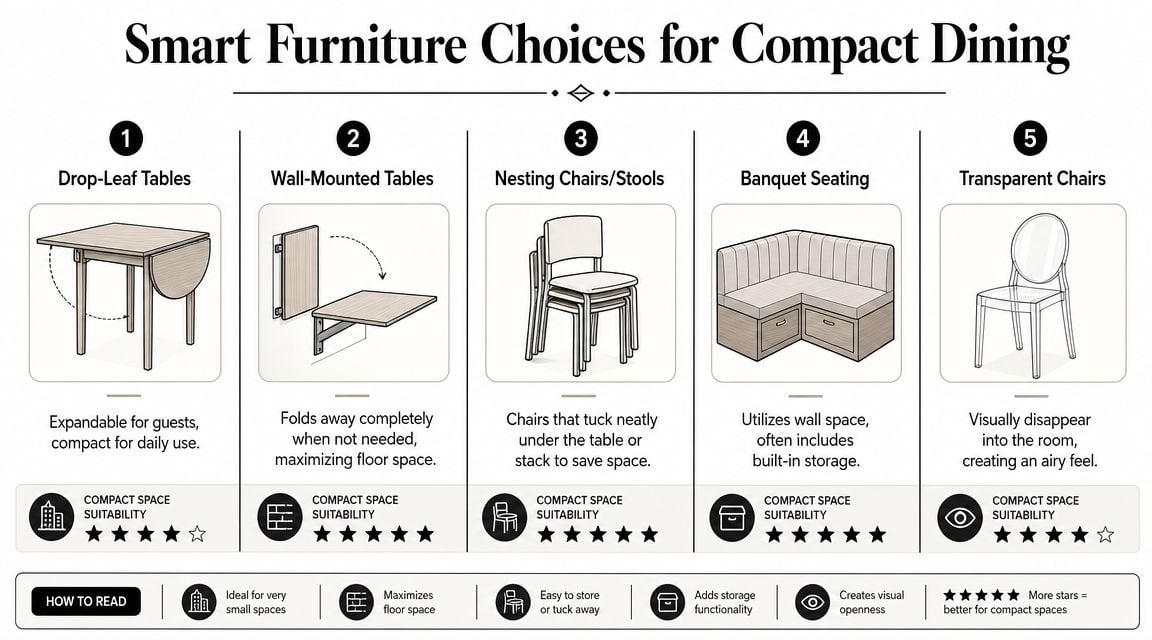
The strongest small-space pieces do more than one job. A drop-leaf table can stay compact during the week and open up when family visits. An extendable table gives you daily efficiency without giving up the option to host. Bar-height sets can also work in some homes, especially where a casual kitchen-dining feel makes more sense than formal seating. This article on whether bar-height dining deserves a closer look can help you decide if that style fits your routine.
What tends to work well:
- Pedestal tables: Easier legroom and easier chair placement.
- Drop-leaf styles: Good for multipurpose rooms where floor space matters.
- Extendable designs: Useful for households that host occasionally, not daily.
- Benches paired with chairs: A practical mix when one side sits against a wall.
What usually disappoints:
- Bulky trestle bases in tight nooks.
- Deep upholstered host chairs that look inviting but eat up space.
- Oversized sets sold as a package without regard for room shape.
For long-term satisfaction, pay attention to build quality as much as footprint. Brands such as Flexsteel or Ashley are worth considering because dining furniture in a small home gets constant use. It's not background furniture. It becomes part of how the house functions every day.
Smart Storage and Lighting Solutions
A small dining area starts to feel finished when it handles the overflow of real life. That means placemats, candles, kids' art supplies, serving bowls, chargers, and all the little items that otherwise end up stacked on the tabletop.
The smartest rooms solve that problem subtly, without adding visual heaviness.

Storage that supports daily life
Expert guidance for compact dining areas consistently points toward multi-functional furniture. Benches can replace several chairs, corner seating can reclaim awkward areas, and built-in storage helps the room stay useful without feeling crowded, as explained in this small dining area design article.
That advice matters most when storage is matched to how you live. A family with school-age kids may need hidden storage in a bench for coloring supplies or chargers. A couple in an apartment may get more value from a slim sideboard that stores linens and doubles as serving space.
A few practical combinations work especially well:
- Storage bench plus compact table: Strong option when one wall is already fixed by a window or corner.
- Narrow sideboard: Useful if you need a landing zone for dishes, baskets, or seasonal pieces.
- Wall shelving or a hutch: Keeps the floor open while using vertical space.
Lighting that defines the dining zone
Lighting doesn't create square footage, but it changes how a small space reads. In an open-plan home, a pendant above the table helps define the dining area so it feels intentional rather than squeezed in. In a nook, warm lighting can soften hard edges and make a compact setup feel settled.
Keep horizontal surfaces as clear as possible. In a small dining room, clutter spreads faster than furniture.
If you're deciding between a bench, sideboard, or cabinet, this guide on selecting a dining storage piece walks through the trade-offs well. The right storage should support the room, not dominate it.
Styling Tricks to Make the Space Feel Bigger
Once the layout and furniture are doing their job, styling can make the room feel calmer and more open. But styling only works when the underlying plan works first.
A key rule in small-space design is maintaining at least 36 inches of clear circulation space around the table. That buffer is what allows people to pull out chairs and move comfortably, and when it's ignored, the room feels cramped no matter how nicely it's decorated, according to this small-space dining design guidance.
Use light, reflection, and visual breathing room
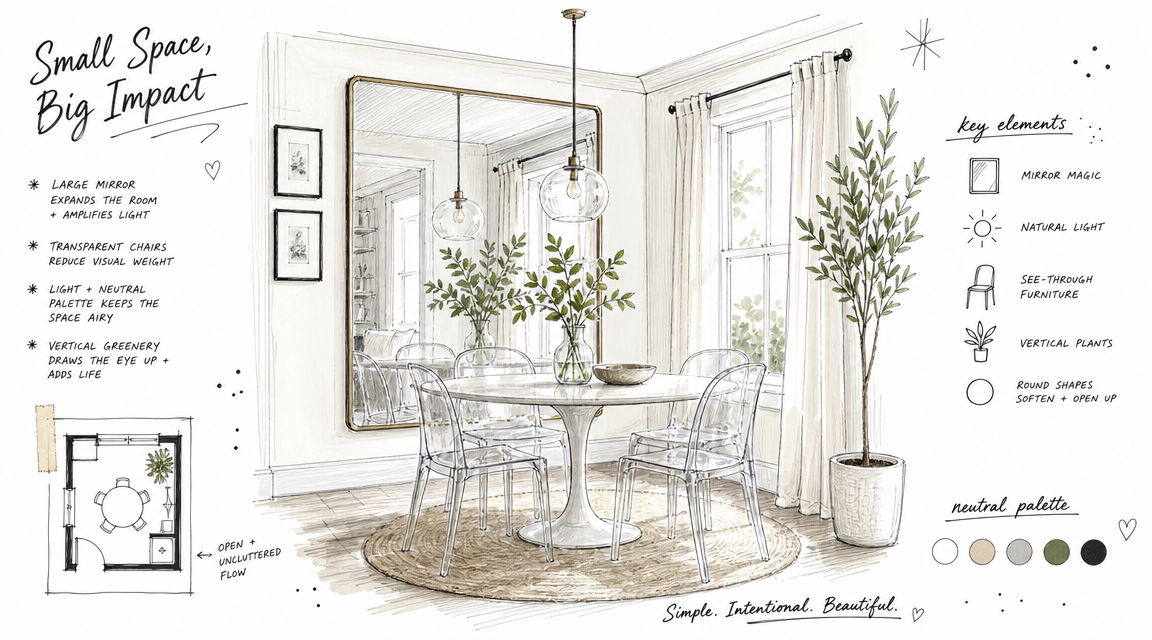
If the room already functions well, a few visual moves can help it feel more generous:
- Add a mirror thoughtfully: It can reflect natural light and extend the sense of depth.
- Choose lighter finishes: Pale walls, softer wood tones, and lighter upholstery often feel less dense.
- Try transparent or open-frame seating: Chairs with less visual weight can make a nook feel less crowded.
- Let windows breathe: Avoid heavy pieces that block light or interrupt sightlines.
Keep the room edited
Small space dining looks better when every visible item belongs there. A centerpiece that's too tall, too many decorative objects, or a rack full of things you never use can shrink the room fast.
A room feels bigger when the eye can travel easily from one side to the other.
For more ideas along those lines, this article on making a small room feel bigger is worth bookmarking. The strongest styling choices are usually the simplest ones.
The Northern Advantage for Your Maine Home
Small space dining can be surprisingly technical. You're balancing footprint, traffic flow, comfort, storage, and how the room feels on a dark winter evening when everyone's gathered around it. That's why many Maine shoppers prefer to sit in the chairs, compare scale in person, and talk through trade-offs before ordering.
For families in Central Maine, that's where Northern Mattress & Furniture 1st can be a useful resource. The company has been family-owned since 1950, now in its third generation, with showrooms in Augusta and Skowhegan. If the floor model isn't the right size, fabric, or configuration, the Custom Order program gives shoppers more flexibility than what's visible on the showroom floor.
A practical shopping advantage is being able to compare everyday solutions side by side. Maybe a compact round table fits your daily routine better than an extendable rectangular one. Maybe a banquette makes sense in a corner, but a bench with hidden storage works better if the room has to stay flexible. Those aren't high-pressure decisions. They're household decisions.
A few store policies also matter for buyers trying to make a careful investment in their home:
- Price Chop promise: Real sale prices, not inflated markups cut down later.
- Simple financing: The Nest Credit Card allows pre-qualification with no credit score impact.
- No-hassle showroom environment: Helpful for people who want guidance without pressure.
- Trusted brand mix and custom options: Useful when standard floor sets don't quite solve the room.
That kind of support matters in small homes because one wrong purchase is harder to hide. In a large dining room, an oversized chair is an inconvenience. In a compact Maine dining nook, it changes the whole room.
If you're ready to find the right fit for your dining nook, visit Northern Mattress & Furniture 1st and stop by the Augusta or Skowhegan showrooms. You can browse styles in a no-hassle setting, ask about Custom Orders, check current Price Chop values, and explore simple financing options while investing in a dining space that will serve your home well for years.