Blog
Innerspring vs Memory Foam Mattress: A Maine Guide

You’re probably here because your current mattress is sending you signals. Maybe you wake up stiff. Maybe your shoulder falls asleep before you do. Maybe one of you sleeps hot while the other wants three blankets even in April. Around Central Maine, that matters more than folks think. Our homes, our seasons, and the way we live all change how a mattress feels night after night.
The innerspring vs memory foam mattress question isn’t really about picking the trendier material. It’s about improving sleep health. Better sleep helps your back, your mood, and how you feel getting through a workday, a snowstorm, or a long stretch of muddy spring chores. The right mattress should fit your body, your sleep position, and your home, not just your budget.
Table of Contents
- Choosing a Mattress for Life in Central Maine
- The Feel of Innerspring The Classic Choice
- The Feel of Memory Foam The Modern Hug
- Side by Side Innerspring vs Memory Foam
- What About Hybrids and Finding Your Personal Fit
- The Northern Advantage Your Local Sleep Experts
Choosing a Mattress for Life in Central Maine
Living in Central Maine teaches you quickly that comfort isn’t static. A mattress that feels fine on a cool October night can feel completely different in July humidity. That’s one reason mattress shopping gets confusing. People assume they’re buying a product, when really they’re choosing how their body will rest through every season.

I’ve had neighbors describe the choice in simple terms. One says, “I want a bed I can move around on without feeling stuck.” Another says, “I need something that takes pressure off my hips.” Both are reasonable. They just point to different mattress feels.
That’s why the innerspring vs memory foam mattress debate can’t be settled with one blanket answer. Your sleep position matters. Your body type matters. Your room temperature matters. If you share a bed, your partner’s habits matter too.
Sleep health gets better when your mattress matches the way you actually sleep, not the way a label says you should.
For heavier individuals over 250 lbs living in climates like Central Maine, mattress choice becomes even more important. Innerspring’s airflow helps with heat retention in humid summers and insulated winter homes, while strong coils can offer lasting support where foam may compress sooner under heavier loads, as noted by Livingoods on innerspring and memory foam differences.
What people often get wrong
A lot of shoppers focus on the first ten seconds in the showroom. Soft can feel “better” right away. Firm can feel “supportive” right away. But neither tells the whole story.
Here’s what usually causes trouble later:
- Mistaking softness for support. A plush surface can still let your body settle in ways that leave your back unhappy.
- Ignoring temperature. If you already sleep warm, trapped heat can turn a comfortable bed into a restless one.
- Shopping only by age of mattress. Wear shows up in sleep quality before it always shows up to the eye. If you’re unsure, these signs you need a new mattress can help you spot the difference.
Start with your nightly reality
Ask yourself a few plain questions.
Do you sleep on your side and wake with sore shoulders? Do you sit on the edge of the bed to tie your boots? Do you get warm at night even in winter? Do you need a mattress that feels steady and easy to move on?
Those answers usually point more clearly than brand names do. Once you know what your body is asking for, innerspring and memory foam start to make a lot more sense.
The Feel of Innerspring The Classic Choice
An innerspring mattress is the traditional one often imagined initially. Inside, it uses steel coils for support. On top, there are comfort layers that soften the feel a bit, but the character of the bed still comes from the springs underneath.
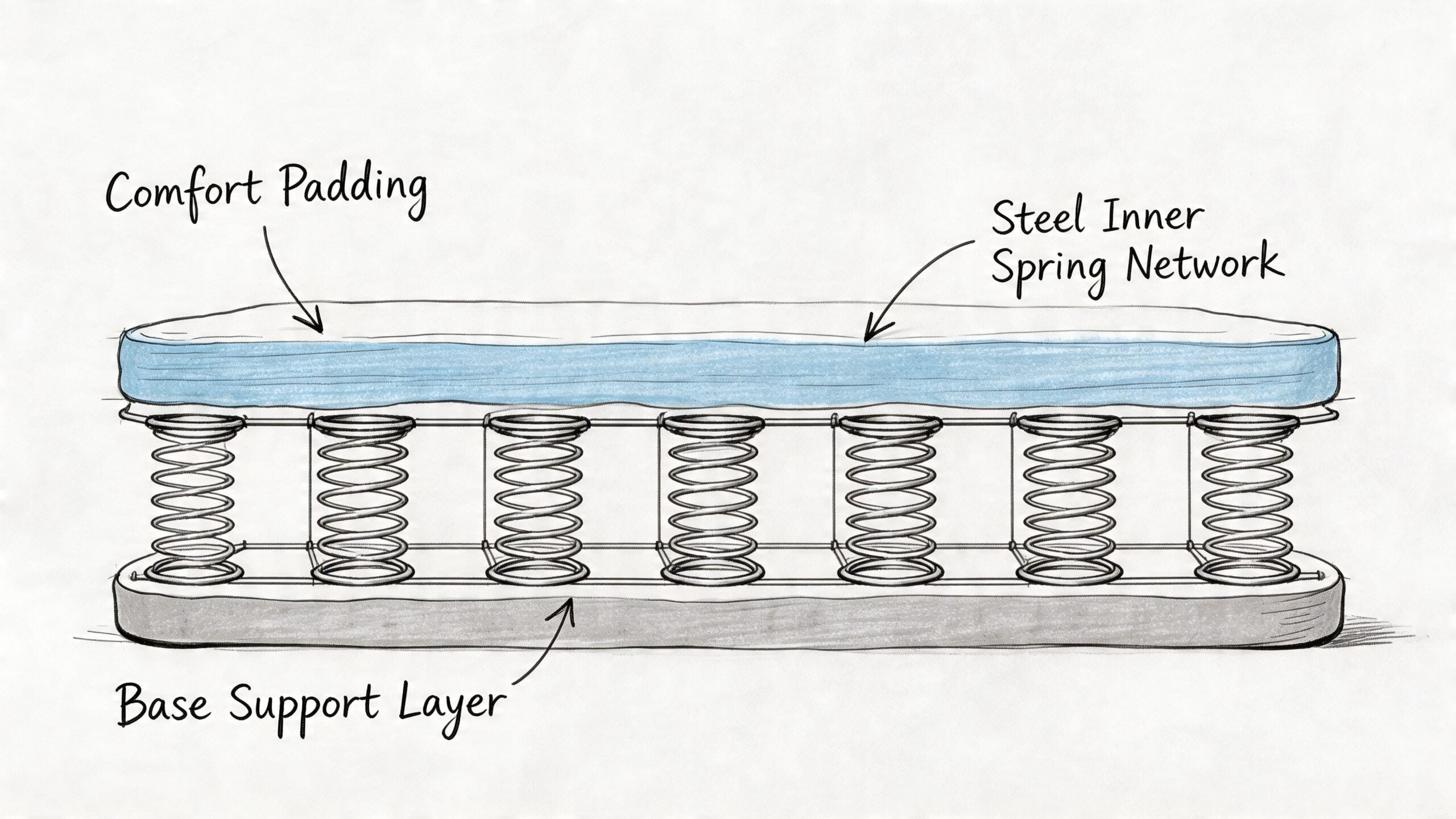
What most folks notice first is the bounce. You lie down, and the mattress pushes back. You don’t sink in much. If you change positions often, that responsiveness can feel natural and easy.
Why innerspring feels cooler and steadier
The space around coils allows air to move through the mattress more easily than standard foam beds. That’s one reason many hot sleepers still prefer innerspring. It doesn’t hug the body as closely, so the surface often feels less stuffy.
It also tends to feel stronger around the perimeter. If you sit on the side of the bed to get dressed or sleep near the edge, that matters. A mattress with decent edge support feels more usable across the full surface.
Practical rule: If you hate the feeling of being “stuck” in bed, innerspring is usually the first type worth trying.
Who often does well on innerspring
In my experience, innerspring makes sense for people who want lift rather than sink. That often includes:
- Back sleepers who want a flatter, more supportive feel under the hips and lower back
- Stomach sleepers who usually need a steadier surface so the midsection doesn’t dip excessively
- Hot sleepers who care more about airflow than body-hugging comfort
- Edge sitters who use the side of the bed constantly and notice collapse right away
A detail shoppers hear about is coil gauge. You don’t need to turn it into homework. Just know that coil construction affects feel and durability, and it’s worth asking questions when you test a mattress in person.
If you’re pairing an innerspring with the right foundation, this guide on why you really do need a box spring for your bed can clear up a lot of confusion.
Where innerspring can fall short
No mattress type is perfect for everyone. A traditional innerspring can transfer more motion, so if your partner rolls over, you may feel it. It may also offer less pressure relief at the shoulders and hips than foam.
That’s why some people lie on an innerspring and say, “This feels supportive,” while someone else says, “This feels too pushy.” Both reactions are honest. The mattress isn’t wrong. It’s just a different feel.
The Feel of Memory Foam The Modern Hug
A memory foam mattress feels almost like the opposite of innerspring. Instead of pushing back quickly, it responds more slowly and contours around your shape. Many people describe it as a gentle hug. That’s a fair description, as long as you know whether you enjoy that sensation.
If innerspring feels like sleeping more on top of the bed, memory foam often feels like sleeping more in it. That difference alone settles the choice for some shoppers within minutes.
Why some sleepers love memory foam
The main reason people choose memory foam is pressure relief. When the foam conforms around the shoulders, hips, and curves of the body, it can feel more forgiving. Side sleepers often notice this first because those pressure points take the brunt of the night.
If you wake up with sore joints, that contouring feel can be a real comfort. It spreads body weight more evenly and reduces the sharp pushback some people feel on firmer coil beds.
Where confusion sets in
Shoppers sometimes think memory foam must mean “too soft.” It doesn’t. Some memory foam mattresses feel plush, while others feel more supportive. What defines the category is the slow response and contouring, not one single firmness level.
The other common concern is heat. Standard memory foam can sleep warmer because it conforms closely and limits airflow. Some newer models use cooling features, but the basic question still stands. If you already run warm, pay close attention to how the bed feels after you’ve been on it a while.
If your partner tosses and turns and you feel every move, memory foam often feels calmer and quieter through the night.
Who often prefers this feel
Memory foam tends to suit people who want a bed that cushions rather than springs back. That can be a strong match for:
- Side sleepers who need more give at the shoulder and hip
- Couples who want less motion transfer
- People with joint sensitivity who want a more contouring surface
- Sleepers who like a cradled feel rather than a buoyant one
If you want a little background on how this material became so common, this short look at the history of mattresses from straw mats to memory foam gives useful context without turning it into a science class.
The tradeoff is simple. Memory foam can feel wonderfully relieving, but some people dislike the slower response. They roll over and feel like the bed takes a moment to catch up. That’s not a flaw. It’s the core personality of the material.
Side by Side Innerspring vs Memory Foam
A side by side view helps once the broad feel is clear. In a Central Maine home, that choice often comes down to what bothers your sleep most. Nighttime heat in July. A partner who rolls over at 4:30 a.m. The sore shoulder that shows up after shoveling season.
The better mattress is the one that helps you sleep more steadily through all of that.
Innerspring vs Memory Foam At a Glance
| Feature | Innerspring | Memory Foam |
|---|---|---|
| Feel | Responsive, bouncy, more on top of the bed | Contouring, slower response, more cradled |
| Motion isolation | More movement may carry across the bed | Better at absorbing partner movement |
| Temperature | Better airflow and cooler feel | Can hold more heat in standard designs |
| Edge support | Usually stronger around the perimeter | Often weaker at the edges |
| Pressure relief | More limited at shoulders and hips | Stronger targeted pressure relief |
| Typical queen price | $500 to $2,200 | $700 to $3,000 |
| Average lifespan | 6 to 8 years | About 10 years |
Price and lifespan ranges above are drawn from Saatva’s comparison of memory foam and innerspring mattresses.
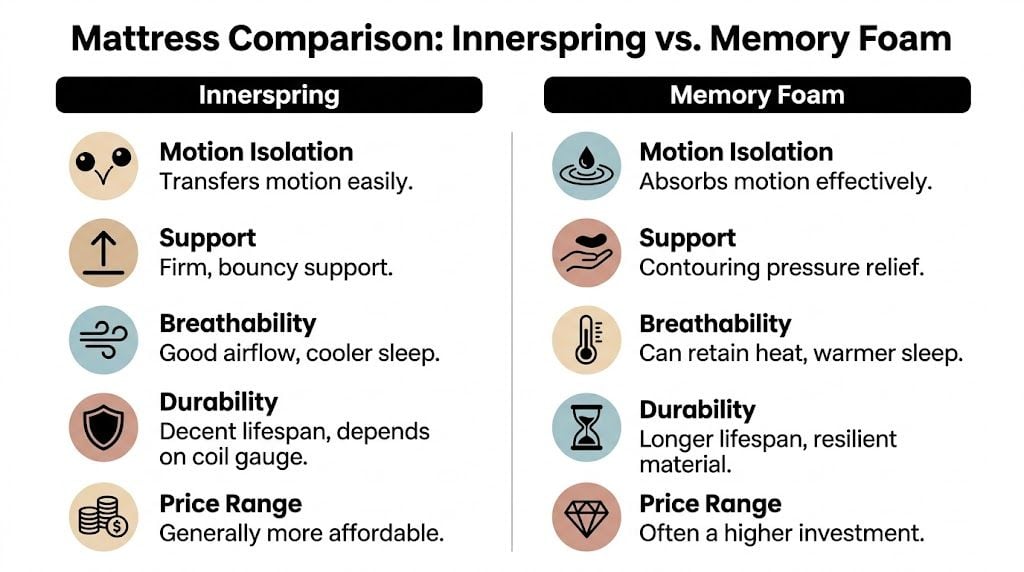
Motion and pressure relief
If one person sleeps lightly and the other moves a lot, memory foam usually keeps the peace better. It absorbs motion instead of sending it across the mattress like a ripple through a dock line on the lake.
That matters more than people expect. A bed can feel fine for five minutes in a showroom, then turn into a nightly interruption once two people share it.
Pressure relief tends to favor memory foam too, especially around shoulders, hips, and joints. Innerspring support can feel steady and upright, but it often does less to cushion the spots that take the most load. For side sleepers or anyone with tenderness in those areas, that difference can shape sleep quality more than the label on the mattress.
Temperature and edge support
Innerspring usually has the edge here. Air moves more freely around coils, so the surface often feels cooler and less close. In a Maine house without perfectly even temperatures year round, that can be noticeable. A mattress that feels comfortable in January may feel very different during a humid stretch in August.
Edge support is easier to understand in person than online. Sit on the side of an innerspring and it often feels more stable, more like a firm bench cushion. Sit on some memory foam models and the edge can compress enough that getting in and out of bed feels less secure. Nectar makes the same general point in its comparison of innerspring and memory foam mattresses.
Durability and price
Many shoppers in Central Maine rightly pause at this decision point. The cheapest bed on the floor is not always the least expensive bed over the years. A mattress is more like a pair of work boots than a sale blanket. You judge it by how it holds up, how it feels after real use, and whether it still supports you once the newness wears off.
Memory foam often lasts longer, while innerspring often costs less up front. Neither fact settles the decision by itself. A guest room in a camp near the lake may call for one answer. The bed you use every night through long winters and muddy spring mornings may call for another.
Body type matters here too, because the same mattress can feel supportive to one person and too firm or too soft to another. If you want a clearer starting point before visiting a store, this guide on which mattress is right for your body type can help you narrow the field.
Then test that hunch in person. Online research gives you the map. Lying down on the mattress, in your usual sleep position, tells you whether the fit will help you sleep healthier at home.
What About Hybrids and Finding Your Personal Fit
A lot of Maine shoppers reach a point where neither camp feels quite right. A plain innerspring can feel a little too springy. All foam can feel a little too enveloping. A hybrid sits in that middle lane.
It uses coils underneath for support and airflow, with foam or similar comfort layers on top for pressure relief. In a real Central Maine home, that mix can make sense. February bedrooms can feel dry and cool. July can turn warm and sticky. A mattress that balances lift with cushioning often handles those swings better for people who do not want an extreme feel either way.
Why hybrids appeal to so many sleepers
A hybrid often gives you a steadier surface than old-style innersprings, but it is usually easier to move on than dense all-foam beds. That matters more than people expect.
If you get up before dawn to feed animals, head to the mill, or let the dog out on a cold morning, ease of movement counts. If you read in bed, sit on the side to pull on socks, or share the mattress with a partner who sleeps differently, that balanced feel can be helpful there too.
Two-person households notice this quickly. One sleeper may want cushioning at the shoulder. The other may want firmer support through the hips and lower back. A hybrid does not solve every disagreement, but it often gives both people more of what they need without pushing the feel too far in one direction.
If you want a clearer explanation of the construction, this guide on what a hybrid mattress is breaks it down well.
Fit matters more than the category
Here is the part online shopping often misses. "Hybrid" tells you the recipe. It does not tell you whether the bed fits your body.
A flannel shirt in your size can still fit wrong in the shoulders. Mattresses work the same way. The label gets you close. Your body gives the final answer.
A good fit depends on a few things working together:
- Sleep position. Side sleepers often need more give at the shoulder and hip. Back and stomach sleepers often need a flatter, steadier feel.
- Body build. Some sleepers need more pushback from the support system. Others need more surface relief.
- Temperature comfort. Some people sleep warm year round, even in a Maine winter. Others want a cozier, more tucked-in feel.
- How you move at night. If you change positions often, a mattress that lets you move without effort can improve sleep quality.
As noted earlier, foam and innerspring models can differ in lifespan and upfront cost. That still does not settle the choice. A mattress is only a good value if it helps you sleep well in your own room, with your own habits, through all four seasons.
That is why I always tell neighbors to use online research as a starting point, then confirm the fit in person. Lie down the way you sleep. Roll to your side. Sit on the edge. Stay there long enough for your body to stop being polite and start being honest.
Sleep health comes first. The label comes second.
The Northern Advantage Your Local Sleep Experts
A mattress can sound right online and still feel wrong on a February night in Central Maine.
That happens more than people expect. A bed that seems cozy in a short showroom test can sleep too warm once the house is buttoned up for winter. A model that feels firm and supportive in July can feel a little different when the room cools off and the materials stiffen. Add in muddy spring days, open-window summer nights, and long stretches of heating season, and you start to see why local context matters.
That is where a nearby showroom earns its keep. You are not only comparing innerspring to memory foam. You are checking how each one might live in your own bedroom, with your room temperature, your bed frame, your sleep habits, and the way your body feels at the end of a Maine workday.
Why in person testing still matters
Online research is useful. It helps you narrow the field. The final choice still needs a body on the mattress.
A good in-person test is simple:
- Lie down in your real sleep position. Side, back, stomach, or a mix of all three
- Stay there for a few minutes. Your body often needs time to notice pressure at the shoulder, hip, or lower back
- Roll and change positions. Some beds welcome movement. Others make you work for it
- Sit on the edge. That matters if you get dressed there, read there, or need a steady perch when getting in and out of bed
- Talk through your setup at home. Room temperature, foundation, bed partner, and even whether you sleep with flannel in January or lighter bedding in August can change what feels right
That process sounds plain because it is plain. Good mattress shopping usually is. It works a lot like fitting a pair of boots. The size on the box helps, but your feet still need to walk in them.
What local guidance changes
A good local store helps translate all that research into a real fit. The value is not fancy wording. The value is having someone ask the kind of questions that affect sleep health. Do your hands go numb on your side? Do you wake hot in every season or only in summer? Does your lower back feel better with a flatter surface or a little more cushioning?
Those questions matter in Central Maine homes because the bedroom itself changes through the year. Heating season can dry the air and change how warm a bed feels. Older homes can have cooler upstairs rooms. Some couples want a mattress that feels snug in winter but not stuffy in August. Those are not small details. They are part of daily sleep.
Local stores can help in other practical ways too:
- Pricing is easier to judge when it is explained plainly. That makes it simpler to compare materials, comfort, and expected lifespan
- Payment options can lower stress. A mattress is a health purchase for many households, so flexible budgeting can help people buy for fit instead of rushing toward the cheapest option
- Special orders can widen your choices. Sometimes the right comfort or size is not the exact model sitting on the floor, and a store should be able to walk you through those options clearly
Northern Mattress & Furniture 1st is one local option with showrooms in Augusta and Skowhegan where shoppers can compare innerspring, memory foam, and hybrid mattresses in person and talk through fit in a low-pressure setting.
That local step matters because sleep health is personal. The better question is not which mattress type wins on paper. The better question is which one helps you wake up with fewer aches, steadier support, and better rest in a real Central Maine home.
If you want to continue your research in person, visit Northern Mattress & Furniture 1st. You can compare innerspring, memory foam, and hybrid options and see how each one feels for your body, your sleep style, and your home.